
Hi everyone! I have an interest in fuel cells, so I decided to write a post on them. Fuel cells are a hot topic right now and are being investigated as an environmental option to power cars, trucks, buildings, and planes. They run on hydrogen, so about a year ago, the United States government set goals to establish hydrogen hubs across the country and reduce the cost of green hydrogen to 1 U.S. dollar per kilogram (Silverstein). Fuel cells and fuel cell vehicles are specialized technology that will continue to become more prevalent in the future.
What are fuel cells?
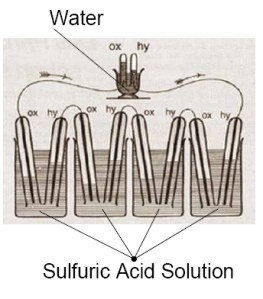
Although fuel cells are a hot topic, they are not a new one. The first fuel cells were built around 1842 by William Grove, who managed to both generate an electric current and produce water through a reaction involving hydrogen and oxygen. Grove’s fuel cells involved series circuits of platinum electrodes. Each “cell” of the series had two platinum electrodes, one in a tube filled with oxygen and one in a tube filled with hydrogen. The bottoms of the tubes and electrodes were dipped in a dilute sulfuric acid solution, which conducted current between the electrodes (Poffenberger).
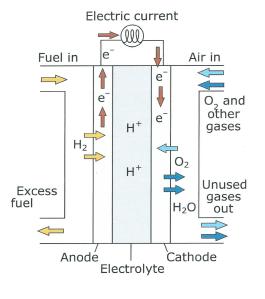
Fuel cells have changed a bit over the past 180 years, but the basic idea is still the same. All fuel cells have a negative electrode, or anode, and a positive electrode, or cathode, that are separated by an electrolyte. A fuel, like hydrogen, is fed to the anode, while air is fed to the cathode (“Fuel Cell Basics”). A catalyst at the anode separates hydrogen into its protons and electrons, which each take a different path to the cathode. The electrons take an external circuit, which creates an energy flow, while the protons travel directly through the electrolyte. When both the electrons and protons reach the cathode, they react with the oxygen there to produce water and heat (“Fuel Cells”).
Fuel cells are similar to batteries, but they never run down or need recharging. They produce electricity and heat as long as they have fuel (“Fuel Cell Basics”).
There are many types of fuel cells, including direct-menthol and alkaline varieties, but polymer electrolyte membrane (PEM) fuel cells are the best for cars. In a PEM fuel cell, hydrogen and oxygen react to make water, electricity, and heat. Regenerative or reversible fuel cells are useful for energy storage. They can both make electricity and water out of hydrogen and oxygen and use electricity to separate water back into hydrogen and oxygen, which can later be reacted to produce more electricity (“Fuel Cell Basics”).
How are fuel cell vehicles better than gasoline powered cars?
- Fuel cell cars produce no tailpipe emissions, but only water vapor and warm air (“Fuel Cell Electric Vehicles”). Their lack of emissions is helpful since regular gasoline powered cars emit not only lots of greenhouse gases but also poisonous smog including nitrogen oxide, carbon monoxide, and formaldehyde. Smog triggers dangerous lung diseases like asthma, emphysema, and chronic bronchitis. In 2018, about 125 million people in the U.S. lived in unhealthy air (“Light Duty Vehicle Emissions”).
- Hydrogen is non toxic and lighter than air, which means that it dissipates quickly. As a result, a person is unlikely to be poisoned by a hydrogen leak (“Safe Use of Hydrogen”).
- Fuel cell cars are more efficient than gasoline powered cars, partially due to their regenerative braking systems. Their braking systems capture the energy that would normally be lost during braking and store it in a battery to be used later (“Fuel Cell Electric Vehicles”).
- Fuel cells diversify the transportation economy and make the United States less dependent on foreign oil and gas (Accardi).
How are fuel cells better than other electric cars?
- The main benefit that fuel cell cars have over electric cars is that they fuel up in about four minutes (“Fuel Cell Electric Vehicles”), while electric cars take at least half an hour to charge and usually much longer. As an illustration, a Tesla Model 3 Long Range takes 10 hours to fully charge at a standard Level 2 charging station (Loveday). Fuel cell cars travel about 300 miles after a four minute fuel up (“Fuel Cell Electric Vehicles”), while average electric cars travel the same distance after charging for many hours (Bogna).
What are some drawbacks to hydrogen fuel cell cars?
Fuel cell cars are not perfect, but most of their problems will be solved as new technology and infrastructure are developed.
- The biggest problem with fuel cell cars is that most hydrogen is not green. At least 95% of it is produced in reactions that involve coal and natural gas and that release greenhouse gases (Silverstein, “Hydrogen Fuel Basics”). However, the production emits only half the greenhouse gases of combustion engine cars and uses up only one tenth of the petroleum (“Hydrogen Production: Natural Gas Reforming”). A small percentage of hydrogen is made through renewable energy and other green methods. In June 2021, the United States Energy Department decided to increase the availability of green hydrogen by setting a goal to reduce its cost from 5 dollars per kilogram to 1 dollar per kilogram in one decade (Silverstein).
- Another concern about hydrogen fuel is that it can light on fire more easily than gasoline or natural gas. It has a wider range of flammable concentrations in air and needs less ignition energy. However, hydrogen is safe as long as the systems containing the fuel are well designed, and people are educated on how to handle it properly (“Safe Use of Hydrogen”).
- Fuel cell cars are currently very expensive. The few cars on the market sell for about USD 80,000 each. As they become more common, the cost will go down (“Hydrogen fuel cell cars: everything you need to know”).
- Currently there is little infrastructure for fuel cell cars, including few fueling stations. A year ago, Congress passed a Bipartisan Infrastructure Bill that includes 7 billion dollars to set up six to ten regional hydrogen hubs across the country. The goal of the hubs is to connect producers and consumers and accelerate the use of clean hydrogen (Silverstein).
- At the moment, hydrogen tanks take up a lot of space, so fuel cells can only be used in large models of cars. That is one of the reasons fuel cell cars are more expensive. (“Hydrogen fuel cell cars: everything you need to know”).
How is hydrogen produced in the first place?
Most hydrogen is produced through either natural gas reforming or electrolysis. Natural gas reforming occurs when steam reacts with hydrocarbon fuel to produce hydrogen, while electrolysis is a process in which an electrolyzer separates water into hydrogen and oxygen with an electric current. Other methods of hydrogen production are either solar-driven or biological. Some solar-driven production methods are photobiological, where bacteria and green algae produce hydrogen through photosynthesis, or photoelectrochemical, where semiconductors separate water into hydrogen and oxygen (“Hydrogen Fuel Basics”). One biological method of hydrogen production is microbial biomass conversion, where microbes release hydrogen as they consume and digest organic matter (“Hydrogen Production: Microbial Biomass Conversion”). While the idea of cultivating microorganisms to produce hydrogen sounds bizarre, oil-eating microbes are already being used to produce hydrogen from abandoned oil wells (Blain), while vinegar processing ones were able to extract 91% of the hydrogen out of vinegar (“Microbes Churn Out Hydrogen at Record Rate”).
How does a fuel cell car work?
Fuel cell cars have propulsion systems like those of electric vehicles, but their energy is stored as hydrogen gas in a tank instead of in a battery. Their fuel is converted to electricity by the fuel cell (“Fuel Cell Electric Vehicles”).

Hydrogen fuels everything in the car either directly or indirectly. Hydrogen fuel goes from the fuel tank to the fuel cell, where it is converted into electricity. The battery pack also holds electricity that it absorbs from regenerative braking. Both sources power the electric traction motor and transmission, which turn the car’s wheels. The power electronics controller regulates the amount of electricity that enters the electric traction motor, the speed of the motor, and its torque, while the thermal cooling system makes sure that everything stays at the correct temperature. Fuel cell cars also have auxilary batteries, which provide electricity to start the cars and run vehicle accessories. Electricity is transferred from the battery pack to the auxilary battery by the DC/DC converter, which converts the high voltage power of the battery pack to a lower voltage. (“How Do Fuel Cell Electric Vehicles Work Using Hydrogen?”).
From Forklifts to Airplanes: Larger Fuel Cell Powered Vehicles
Large vehicles such as planes, trains, ships, and long-haul trucks are difficult to make electric, but it is possible for them to run on fuel cells. A study by Clean Sky 2, a respected aeronautical research partnership, estimates that the first hydrogen powered aircraft could be produced by 2035, and aircraft for longer flights could be ready by 2050. Airlines will likely be eager to use hydrogen fuel since many of them are testing environmental alternatives to regular jet fuel. As an illustration, British Airways, Jet Blue, Scandinavian Airlines, United Airlines, Virgin Australia, and Virgin Atlantic have all tried biofuels on commercial flights, while Delta recently purchased 385 million gallons of a new “greener” jet fuel.
Air transportation is not the only kind investigating hydrogen fuel. About 20,000 hydrogen powered forklifts are being used by Walmarts and Targets across the country. FedEx drives a fuel cell powered delivery truck in New York State. In addition, National Grid intends to become a corporate buyer of hydrogen fuel once it is more established. As the costs drop and the government sets up regional hydrogen hubs, more vehicles and appliances will be run on hydrogen (Silverstein).
Conclusions
Fuel cells will be more prevalent in the future, so learning about them now will come in handy. I want to buy a fuel cell car, but I am planning to wait until they get cheaper!
Sources
Here are my sources for this post. Feel free to check them out for more information.
Accardi, Michael. “Sustainable Hydrogen Fuel Is Around the Corner: Advancements in the Aviation Industry are Promising.” Muscle Cars and Trucks, Nov. 15, 2022, http://www.musclecarsandtrucks.com/sustainable-hydrogen-fuel-is-around-the-corner/. Accessed Nov. 30, 2022.
Blain, Loz. “Oil-eating microbes excrete the world’s cheapest “clean” hydrogen.” New Atlas, Oct. 3, 2022, newatlas.com/energy/cemvita-microbe-hydrogen. Accessed Dec. 2, 2022.
Bogna, John. “How Far Can an Electric Vehicle Go on One Charge?” How-To-Geek, Jun. 25, 2022, http://www.howtogeek.com/807750/how-far-can-an-electric-car-go/amp/. Accessed Dec. 1, 2022.
“Fuel Cells.” Office of Energy Efficiency and Renewable Energy: Hydrogen and Fuel Cell Technologies Office, www.energy.gov/eere/fuelcells/fuel-cells. Accessed Dec. 13, 2022.
“Fuel Cell Basics.” Office of Energy Efficiency and Renewable Energy: Hydrogen and Fuel Cell Technologies Office, http://www.energy.gov/eere/fuelcells/fuel-cell-basics. Accessed Nov. 30, 2022.
“Fuel Cell Electric Vehicles.” U.S. Department of Energy: Alternative Fuels Data Center, afdc.energy.gov/vehicles/fuel_cell.html. Accessed Dec. 1, 2022.
“How Do Fuel Cell Electric Vehicles Work Using Hydrogen?” U.S. Department of Energy: Alternative
Fuels Data Center, afdc.energy.gov/vehicles/how-do-fuel-cell-electric-cars-work. Accessed Dec. 2, 2022.
“Hydrogen fuel cell cars: everything you need to know.” BMW, Dec. 5, 2019, http://www.bmw.com/en/innovation/how-hydrogen-fuel-cell-cars-work.html. Accessed Dec. 5, 2022.
“Hydrogen Production: Electrolysis.” Office of Energy Efficiency and Renewable Energy: Hydrogen and Fuel Cell Technologies Office, http://www.energy.gov/eere/fuelcells/hydrogen-production-electrolysis. Accessed Dec. 2, 2022.
“Hydrogen Production: Microbial Biomass Conversion.” Office of Energy Efficiency and Renewable Energy: Hydrogen and Fuel Cell Technologies Office, http://www.energy.gov/eere/fuelcells/hydrogen- production-microbial-biomass-conversion. Accessed Dec. 2, 2022.
“Hydrogen Production: Natural Gas Reforming.” Office of Energy Efficiency and Renewable Energy: Hydrogen and Fuel Cell Technologies Office, http://www.energy.gov/eere/fuelcells/hydrogen-production- natural-gas-reforming. Accessed Dec. 2, 2022.
“Hydrogen Production: Photobiological.” Office of Energy Efficiency and Renewable Energy: Hydrogen and Fuel Cell Technologies Office, http://www.energy.gov/eere/fuelcells/hydrogen-production- photobiological. Accessed Dec. 2, 2022.
“Light Duty Vehicle Emissions.” EPA: United States Environmental Protection Agency, http://www.epa.gov/greenvehicles/light-duty-vehicle-emissions. Accessed Dec. 1, 2022.
Loveday, Steven. “How Long Does It Take to Charge an Electric Car?” U.S. News & World Report, Feb. 23, 2022, cars.usnews.com/cars-trucks/advice/ev-charging-time. Accessed Dec. 8, 2022.
“Microbes Churn Out Hydrogen at Record Rate.” National Science Foundation, Nov. 12, 2007, http://www.nsf.gov/news/news_summ.jsp?cntn_id=110648. Accessed Dec. 2, 2022.
Poffenberger, Leah and Alaina G. Levine. “This Month in Physics History: October 1842: William Grove’s Letter to Faraday Describing a Fuel Cell.” APS News, Edited by David Voss, vol. 28, no. 9, Oct. 2019, www.aps.org/publications/apsnews/201909/history.cfm. Accessed Dec. 13, 2022.
“Safe Use of Hydrogen.” Office of Energy Efficiency and Renewable Energy: Hydrogen and Fuel Cell Technologies Office, http://www.energy.gov/eere/fuelcells/safe-use-hydrogen. Accessed Dec. 1, 2022.
Silverstein, Ken. “The Hydrogen Economy Will Soon Be Ready For Take Off, Including Planes and Power Plants.” Forbes, Nov. 6, 2022, http://www.forbes.com/sites/kensilverstein/2022/11/06/the-hydrogen- economy-will-soon-be-ready-for-take-off-including-planes-and-power-plants/. Accessed Dec. 1, 2022.

 Owl Tree View