
-
Final Post

Hi everyone! This is my last post on Owl Tree View. I’ll be starting college in a couple weeks, and I won’t have time to write this blog anymore. Thank you so much to anyone who has read, liked, or commented on my posts! I’m grateful for your support. I’ve really enjoyed researching and writing my articles, and discussing them with you in the comments. I wish you all well, and I look forward to continuing my writing at my college’s newspaper.
-
How difficult is it for people to immigrate to the United States?

Hi everyone! The United States is a country built by immigrants. In fact, over 98% of its population is descended from them (“Native Americans and the U.S. Census”). Currently, immigration is a hot topic, so I wanted to examine modern laws to determine how difficult it is for people to legally immigrate to the United States today.
How does a person become a United States citizen?
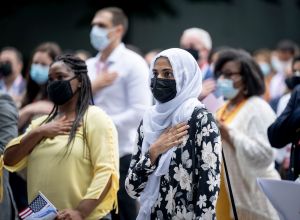
Citizenship Day Naturalization Ceremony at the Lincoln by U.S. Department of Homeland Security (Source) is licensed under CC-CC0 1.0 In order to become a citizen, a person first needs to become a Lawful Permanent Resident (LPR), which is the same as having a green card. After living in the United States for five years (or three under certain circumstances), LPRs can apply for citizenship. LPRs have similar privileges to citizens since they can apply for most jobs and stay in the country legally regardless of employment status. Unfortunately, it is difficult to become an LPR since the number of green cards issued each year is capped at 675,000. The only exceptions to this cap are for U.S. citizen’s spouses, parents, and children under 21, who can receive unlimited visas. Another restriction on legal immigration is that no group of permanent immigrants from a single country are allowed to exceed 7% of the total people immigrating in a given fiscal year. The 7% limit was mainly intended to prevent any one country from dominating immigration, but it serves to increase a backlog of pending immigration cases (“How the United States Immigration System Works”). Foreign students, tourists, and some other noncitizens who are admitted temporarily do not fall under the numerical caps. However, in order to apply for LPR status, people must go through a handful of specific avenues, such as family-based visas, work-based visas, and seeking asylum (“How the United States Immigration System Works”).
Path #1 to Apply for LPR Status: Family-Based Immigration
Family-based immigration is the main pathway to legal residence in the United States. In 2019, family-based immigrants made up 68.8% of all new LPRs. An unlimited number of visas are given to citizen’s spouses, parents, and unmarried children under age 21, while roughly 480,000 visas are available through a family preference system. The family preference system is for the adult children, brothers, and sisters of United States citizens and the spouses and children of LPRs. In order to sponsor one’s relative in family-based immigration, a person must file a sponsor petition for her, prove a legitimate family relationship, meet minimum income requirements, meet age requirements, and sign an affidavit that he will financially support his relative. The person immigrating needs a medical exam and required vaccinations and has to prove that she will not become dependent on the government to support herself. The government, in turn, analyzes her immigration and criminal history. Although family members have to jump through hoops to help their relatives migrate to the United States, family-based immigration is still fairly successful (“How the United States Immigration System Works”).
Path #2 to Apply for LPR Status: Employment

A sample permanent resident card (green card) in 2010. Part of the Wikipedia article “Green card”. Courtesy of Wikipedia and U.S. Citizenship and Immigration Services (USCIS). Roughly 13.5% of all new LPRs are admitted to the United States due to their employment. Many immigrants have temporary work visas, but most people with those visas have to leave the country when their status expires or employment ends. However, some of them can become LPRs if they are sponsored by their employers. Applying for an employment-based green card has a number of time consuming steps that vary depending on the immigrant’s visa category and whether or not the person is already in the United States. If she is residing in a foreign country, her visa application can’t even be filed until after U.S. Citizenship and Immigration Services (USCIS) approves her immigration petition. For foreign workers in some categories, their employer sponsors are legally required to test the labor market with the Department of Labor and confirm with the Secretary of Labor that their employee’s petition meets certain criteria. After that, either the employer or the employee can submit an application to USCIS, and finally the immigrant is required to submit another application to either adjust her status to LPR or apply at a United States embassy abroad. All of that is an uncertain and time consuming process due to the backlogs in the United States immigration system (“How the United States Immigration System Works”). The cap for permanent employment-based immigration is roughly 140,000 people a year, which includes immigrants’ eligible spouses and unmarried minor children. The work visa preference system selects people with exceptional abilities and advanced degrees over average or unskilled workers (“How the United States Immigration System Works”). As a result, only specific people can immigrate through their employment.
Path #3 to Apply for LPR Status: Coming As A Refugee
Refugees are admitted to the United States since they cannot safely live in their home countries due to a “well-founded fear of persecution.” Persecution happens when a person is targeted by discrimination and hate crimes because of his race, political opinion, religion, national origin, or membership in a particular social group. Refugees apply for aid outside the United States, usually from a “transition country” that’s different from their home country. Admission of refugees depends on the amount of risk they face, whether they have family in the United States, and whether they are in a group designated by the president and Congress as being of special concern. Each president and Congress sets the ceiling for refugee admissions. After 9/11, the refugee ceiling dropped abruptly, but then rose again until it was 111,000 in 2017. Over the Trump administration, the ceiling dropped until it reached 18,000 in 2020. When Biden took office in 2021, he raised the ceiling to 62,500, but admissions were so slow that the United States only took in 7,637 refugees in Fiscal Year 2021. Refugee admissions continue to be very slow (“How the United States Immigration System Works”). While refugees are not automatically granted LPR status, they can apply for and obtain LPR status one year after admission into the United States (“How the United States Immigration System Works”).
Path #4 to Apply for LPR Status: Coming As An Asylee
Asylum is given to people who are unable or unwilling to return to their home countries because they are either being persecuted or afraid of being persecuted “on account of race, religion, nationality, membership in a particular social group, or political opinion.” Extreme poverty and starvation are not legitimate reasons to be granted asylum (“Asylum in the United States”). Asylees are the same as refugees, except that they are applying for aid within the United States instead of from a foreign country. A person can either apply for asylum at a port of entry or within one year of entering the United States (“How the United States Immigration System Works”). Immigrants want asylum because it allows them to legally live and work, petition to bring other family members, potentially receive aid from government programs like Medicaid, and apply for LPR status after living in the country for one year. Asylum is a discretionary status since there is no law saying that everyone who fits the definition of a refugee has to be given asylum (“Asylum in the United States”). However, asylum seekers are not restricted by number limits or any specific criteria. About 46,508 people were granted asylum in Fiscal Year 2019 (“How the United States Immigration System Works”).
One reason why asylum is a hot topic is that a huge number of families and unaccompanied children have been crossing the United States- Mexico border to seek asylum. In the past, most people crossing illegally were single adults trying to avoid capture. In 2012, only 10% of the migrants crossing the border were families and children, and that percentage was unusually high. From October 2018 to February 2019, 61% were families and unaccompanied children. Most of them are asylum seekers who either turn themselves in to Border Patrol officers or wait for the Border Patrol to find them (Isacson). That situation has created a humanitarian crisis. Detention centers (Isacson) and homeless shelters have been overwhelmed (Ainsley), and many people have died trying to cross the border. In one instance, Border Patrol Agents rescued 17 people from the cold Rio Grande River on a day in February. Sixteen of them were Hondurans, and one was a three-year-old Guatemalan child. Its unclear if the child’s family died, if the child had been human trafficked, or if he or she had been traveling alone (Davis). It is necessary to understand asylum in order to handle the humanitarian crisis at the border.

The information in this chart is from the source “Legal Immigration and Adjustment of Status Report Fiscal Year 2022, Quarter 4”. Refugees and asylees are two of the groups under the “Other” section. In order to be granted asylum, seekers must prove that they fit the definition of refugees and provide evidence that they have either suffered persecution or have a “well-founded fear” of suffering persecution. Most people who arrive at a port of entry or enter the United States illegally apply for defensive or expedited asylum, which is for those being deported (“Asylum in the United States”). Asylum seekers are given “credible fear” interviews to determine their eligibility. If a seeker was deported before, he or she will be given a “reasonable fear” interview instead, which determines his or her eligibility for a separate designation named “withholding of removal.” Frequently, the Department of Homeland Security does not have the capacity to hold people for interviews, so they are released at the border with a notice to appear in court. Otherwise, long immigration case backlogs can cause people to be detained for years waiting for their “credible fear” interviews (“Asylum in the United States”).
A number of barriers bar people from seeking asylum. For starters, a person is not allowed to apply for asylum if she did not apply within her first year of entering the United States. That deadline is easily missed due to lengthy backlogs or if the applicant does not know about it. Many people are denied asylum exclusively because they miss the one year deadline. Another barrier is that many migrants have no legal council (“Asylum in the United States”). People with lawyers are five times more likely to be granted asylum, but many are unable to find or afford them (Isacson). Detention negatively effects people’s immigration cases because people who are detained are much less likely to find attorneys (“Asylum in the United States”).
Another problem is the immigration courts’ giant backlogs. On April 1, 2022, a backlog of 470,786 affirmative asylum cases were pending, and in July 2022, 1.82 million removal cases were open. Compare those numbers to the 46,508 people granted asylum in Fiscal Year 2019. Simply scheduling an interview can take as much as four years. In May 2022, the average seeker had waited 1,508 days (a little over 4 years) to be granted asylum. Over those years, seekers and their overseas families are left in limbo. After the first 150 days (5 months) of their cases pending, asylum seekers are allowed to apply for work, which they use to support themselves over the next years (“Asylum in the United States”).
The huge backlogs are partly due to the COVID-19 pandemic. Over the pandemic, 2.2 million asylum seekers were expelled from the United States due to Title 42, a pandemic related health policy, and the Remain in Mexico protocols forced others to remain in Mexico until their claims were processed. Now, both policies have been terminated (“Asylum in the United States”).
Possible Measures That Could Alleviate the Humanitarian Crisis
1. Increasing the number of immigration courts and hiring more judges so that the asylum system won’t have such long backlogs.
2. Giving asylum seekers better access to legal council. Seekers are five times more likely to be granted asylum if they have a lawyer, but many can’t afford to hire them (Isacson).
3. Expanding alternatives to detention programs. For instance, a program having case workers keep in touch with asylum seeking families was very successful and much cheaper for the government than detaining the families (Isacson).
4. Allowing people to seek asylum for extreme poverty. People who are starving are just as desperate as those fleeing from persecution.
5. Starting a general path for people to apply for LPR status regardless if someone has family in the United States, is qualified for asylum, or has a job in the country.
6. Creating a process for people to apply for visas from their home countries (Nunez-Neto).
7. Working together with Mexico’s asylum system to accommodate migrants from Central America. Mexico recently expanded their system to take on more seekers from Central America (Isacson).
8. Supporting initiatives to decrease corruption in Central America and sending humanitarian aid there.Path #5 to Apply for LPR Status: The Diversity Visa Program
The Diversity Visa program is a computer generated lottery that allocates 55,000 permanent visas to people from countries who have had less than 50,000 of their residents immigrate to the United States over the past five years. Currently, this program helps Africans and Eastern Europeans. It was shut down by immigration bans in 2020, but was reopened in 2021. However, only 3,094 diversity visas were issued in Fiscal Year 2021 (“How the United States Immigration System Works”). In 2022, admissions picked up, and 7% of all new LPRs that year came through the diversity visa program (“Legal Immigration and Adjustment of Status Report Fiscal Year 2022, Quarter 4.”).
Other Legal Statuses for Immigrants
The United States grants multiple types of humanitarian statuses that do not provide a path to permanent citizenship. They are listed below.
1. Deferred Action for Childhood Arrivals, or DACA, allows people who were brought to the United States under age 16 and have lived here since 2007 to remain in the country lawfully and work for the next two years. In order to access the program, a person needs to have graduated high school or college or received a degree equivalent. It is continually renewed every two years. Unfortunately, it offers no path to permanent citizenship (“How the United States Immigration System Works”).
2. Deferred Enforced Departure (DED) protects individuals from deportation if their home countries are unstable. It is at the discretion of the executive branch (“How the United States Immigration System Works”).
3. Temporary Protected Status (TPS) is granted to people who are in the United States but can’t return home due to “natural disaster”, “extraordinary temporary conditions”, or “ongoing armed conflict” (“How the United States Immigration System Works”).
4. Humanitarian parole temporarily admits people to the United States for humanitarian reasons even if they don’t fit the definition of a refugee (“How the United States Immigration System Works”).Becoming A Citizen

Immigrants taking the Oath of Allegiance at Grand Canyon National Park in 2010. Part of the Wikipedia article “Oath of Allegiance (United States)”. Courtesy of Wikipedia and Grand Canyon National Park. After becoming a Lawful Permanent Resident and living in the United States for either three or five years, becoming a citizen is comparatively easy. Prospective citizens must be at least 18 years old, demonstrate good moral character, pay an application fee, and pass English, history, and US civics exams. The exams are waived under certain circumstances (“How the United States Immigration System Works”). Finally, the LPRs become citizens when they take the Oath of Allegiance in a special ceremony (“10 Steps to Naturalization”). Immigrants who become citizens are worthy of respect since they persevered through a long and difficult process to reach their goal.
Conclusion
Researching for this article helped me better understand the steps that immigrants take to become United States citizens and the causes of the humanitarian crisis on the southwest border. I hope it was helpful for you as well. Feel free to share and comment on this post, and feel free to read some of my other blog articles!
Sources
Here are the sources I used for this article. Check them out if you are interested!
“10 Steps to Naturalization.” U.S. Citizenship and Immigration Services, https://www.uscis.gov/citizenship/learn-about-citizenship/10-steps-to-naturalization. Accessed Jul. 18, 2023.
Ainsley, Julia. “Migrant surge overwhelms Border Patrol and shelters in El Paso.” NBC News, Sept. 13, 2022, https://www.nbcnews.com/politics/immigration/migrant-surge-overwhelms-border-patrol- shelters-el-paso-rcna47588. Accessed Aug. 9, 2023.
“Asylum in the United States.” American Immigration Council, published Jun. 11, 2020 and modified Aug. 16, 2022, https://www.americanimmigrationcouncil.org/research/asylum-united-states. Accessed Jul. 18, 2023.
Davis, John. “Border Crisis: CBP’s Response.” U.S. Customs and Border Protection, Jun. 30, 2023, https://www.cbp.gov/frontline/border-crisis-cbp-s-response. Accessed Aug. 9, 2023.
“How the United States Immigration System Works.” American Immigration Council, Sept. 14, 2021, https://www.americanimmigrationcouncil.org/research/how-united-states-immigration-system- works. Accessed Jul. 17, 2023.
Isacson, Adam, Adriana Beltran, and Maureen Meyer. “There is a Crisis at the U.S.-Mexico Border. But its Manageable.” WOLA, Apr. 4, 2019, https://www.wola.org/analysis/fix-us-mexico-border- humanitarian-crisis/. Accessed Jul. 18, 2023.
“Legal Immigration and Adjustment of Status Report Fiscal Year 2022, Quarter 4.” U.S. Department of Homeland Security, https://www.dhs.gov/immigration-statistics/special-reports/legal- immigration. Accessed Aug. 31, 2023.
“Native Americans and the U.S. Census: How the count has changed.” USA Facts, Nov. 21, 2019, https://usafacts.org/articles/native-americans-and-us-census-how-count-has-changed/. Accessed Jul. 17, 2023.
Nunez-Neto, Blas. “Common Sense Solution to the Border Crisis.” The Rand Blog, May 2, 2019, https://www.rand.org/blog/2019/05/common-sense-solutions-to-the-border-crisis.html. Accessed Aug. 15, 2023.
-
Is recycling worth it?
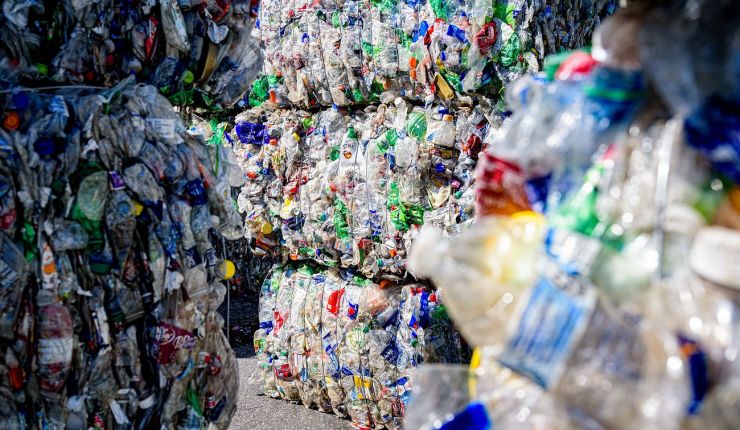
Last year my family took part in a trash cleanup group with some of my neighbors, but it was only recently that I sorted the recyclables that we had picked up. As I pried caps and labels off plastic bottles and shook dirt out of aluminum cans, I began to wonder about the items’ eventual fate. For my last article, I had researched the United States’ problematic practice of shipping recyclables to other countries. I wondered if the items I was sorting would be converted into new bottles and cans or if they would end up cluttering a dump in another country.
Recycling single-use packaging makes sense since the packaging has caused problems worldwide. The increase in single-use items after World War II (Park) led to a myriad of landfills and islands of plastic trash in the ocean. Garbage in landfills takes an estimated 500 years to decompose, and the plastic in them leaches toxic chemicals into the ground (“The Truth About Bioplastics”). As a result, recycling seems better for the environment. However, it is not the best possible option. I wanted to list downfalls of recycling that would be better solved by reducing and reusing waste.
Problem #1: Recycling can create pollution in other countries.
In my last article, I talked about China’s National Sword Policy, which took effect in 2018. The policy banned most recyclables from entering China, only allowing imports of ones with low rates of contamination. As a result, the United States has begun shipping recyclables to many other countries, including Ghana, Cambodia, and Bangladesh. An estimated 20% to 70% of it is thrown away since it is contaminated and thus unusable for recycling. Every year, the United States ships about 1 million metric tons of plastic waste overseas. The waste is harmful for the countries that accept it. For instance, in Southeast Asia, American plastic waste is linked to contaminated water, crop death, respiratory diseases, and organized crime (“Recycling in the U.S. Is Broken”).
In order to learn more about plastic recycling in developing countries, CBC Canada reporters pretended to be plastics brokers in Malaysia (“Tracking Your Trash” 00:00:45-00:00:52). They found that most recycling workers are payed little and labor in dangerous conditions (“Tracking Your Trash” 00:01:10-00:01:25). The reporters also found that Malaysia has many illegal recycling businesses that import huge amounts of plastic (“Tracking Your Trash” 00:01:25-00:01:40), while the country itself is trying to curb the influx of recyclables (“Tracking Your Trash” 00:04:15-00:04:27). They walked over hills of Canadian and American plastic bags at the plant of an illegal recycler that had been shut down. Now the plastic sat there, polluting the land (“Tracking Your Trash” 00:02:15-00:03:21). Malaysia’s environment minister had recently shut down 150 illegal recyclers (“Tracking Your Trash” 00:04:30-00:04:45). because they had been dumping and burning huge amounts of contaminated materials. Burning plastic constantly filled the air with smoke and fumes and killed its pristine forest (“Tracking Your Trash” 00:06:10-00:07:35). One woman that the reporters interviewed was concerned that her young son was becoming sick from the awful air (“Tracking Your Trash 00:08:00-00:08:42). Nearby, the reporters found tiny plastic pellets being ejected downriver from a recycling plant. Many people in a nearby town fished and farmed with the river’s water, which explained why some of them were becoming ill (“Tracking Your Trash” 00:09:40-00:11:00). According to one Malaysian activist, she was protesting the situation because she did not want her country to become an “international rubbish bin” (“Tracking Your Trash” 00:10:10-00:10:19).
Problem #2: There is little demand for recycled material.
Before China’s National Sword Policy, American communities were able to sell their recyclables to Chinese companies for money, but after the policy took effect, the communities have had to pay to have their recyclables removed. For instance, Bakersfield, California used to earn $65 for each ton of recyclables they sold, but now they have to pay $25 for each ton to be removed. Franklin, New Hampshire used to make $6 a ton selling recyclables. Now, residents can either pay $125 per ton to have them recycled or $68 per ton to have the same materials incinerated. The United States has no federal recycling program, so the National Sword Policy was dealt with differently by each of the 20,000 communities across the country that provide their residents with recycling services (“Recycling in the U.S. Is Broken”).
Problem #3: Most materials cannot be recycled infinitely.
Paper can be recycled between five and seven times, while plastics are usually recycled once or twice. In fact, only plastic No. 1 (PET) and plastic No. 2 (HDPE) are frequently recycled. Plastics with resin codes 3 through 7 are rarely recycled (“Recycling in the U.S. Is Broken”). Metals and glass are exceptions since they can usually be recycled infinitely.
Problem #4: Many plastic recyclables are not recycled.
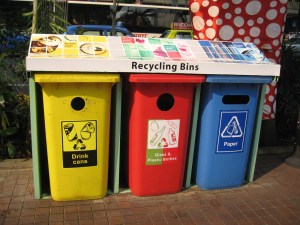
A set of labeled recycling bins. Part of the Wikipedia article “PET bottle recycling”. Courtesy of Wikipedia and its creating user Terence Ong. The recovery rate of plastics is poor. In 2015, Canadians recycled 79% of PET bottles and jars, but only recycled 11% of PET fruit holders and other clamshell containers (Chung). Overall, only 9% of Canadian plastic was recycled (“Tracking Your Trash” 00:17:00-00:17:15). Americans tried to recycle 29% of their plastic bottles in 2017 (Chung), but some of the bottles were contaminated, so ultimately only 21% of them were recycled (“Recycling in the U.S. Is Broken”). Six times more American plastic is incinerated than recycled. The main reason why plastic recycling is rare is that virgin plastic is cheaper than recycled plastic, so economically it makes more sense to produce new plastic (“Recycling in the U.S. Is Broken”). The low cost of virgin plastic is one of the main reasons why recycling is failing.
Problem #5: Some “recycling” companies are not required to recycle their plastic.
In British Columbia, Canada, reporters installed tracking devices on bales of plastic that were brought to different recycling companies (“Tracking Your Trash” 00:11:00-00:12:13). All three bales stayed in British Columbia, but out of three companies, only Merlin Plastics actually recycled the materials they were given (“Tracking Your Trash” 00:13:55-00:14:17). A company named GFL burned the plastic in an energy facility and took the remaining toxic ash to a landfill (“Tracking Your Trash” 00:14:18-00:15:17), while a company named Waste Connections brought the material directly to a landfill (“Tracking Your Trash” 00:15:18-00:16:16”). It turns out that supposed “recycling companies” in Canada are under no legal obligation to recycle the materials that they are given (“Tracking Your Trash” 00:16:16-00:16:35).
Problem #6: Recycling creates its own waste.
Whenever something is recycled, it goes through a chemical process that creates toxic waste. As a result, reducing and reusing are much better options than recycling (“Tracking Your Trash” 00:12:45-00:13:27). Unfortunately, whenever a government tries to ban a plastic item, both plastic producers and recyclers protest the ban, making it difficult to solve the problem (“Tracking Your Trash” 00:17:15-00:19:48).
Problem #7: Psychologically, having a recycling option can cause people to produce more waste.
A study published by Harvard Business Review showed that people use more cups and gift wrap when there is a recycling bin available. That shows that people count on recycling as an effective solution to harmlessly deal with their waste, which it is not (Dell).
How Recycling Works In One State
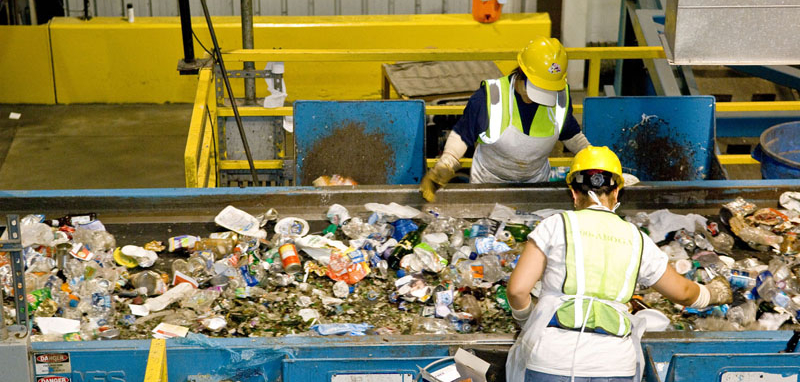
Workers sorting single-stream recycling in a Materials Recovery Facility at the Shady Grove Transfer Station in Montgomery County, Maryland. Part of the Wikipedia article “Recycling”. Courtesy of Wikipedia and the USEPA Environmental Protection Agency. As a case study, I researched the recycling process in my home state of Massachusetts. Massachusetts has nine MRFs, or Material Recovery Facilities, which sort 638,000 tons of materials each year. Recyclables travel through a maze of manual and mechanical sorters, including high-tech equipment like the near-infrared technology that identifies different plastic resin types at the Springfield MRF. Once materials are sorted, the recyclables are crushed into thousand pound bales and sold to companies (“The Truth About Plastics Recycling”). Most paper and cardboard from western Massachusetts are sold to a buyer in eastern Massachusetts (Kaplan). Some plastics are sold to Unifi, a company whose recycling plant is in North Carolina (“The Truth About Plastics Recycling”). Unifi uses the plastic to make fiber, so they turn plastic bottles into carpets, athletic clothing, and elastic straps for masks (“Repreve”). It’s encouraging that Massachusetts has a well designed recycling program. However, it would be better for its residents to reduce their plastic usage.
A Typical PET Recycling Process
Step 1: PET items are collected in recycling facilities, or MRFs.
Step 2: The items are separated from other materials in the MRFs.
Step 3: The objects are squeezed into small bales and transported to a different facility.
Step 4: The bales of plastic are processed by being separated into color streams and ground up into small flakes.
Step 5: The flakes are washed to remove lids, rings, labels, and glue.
Step 6: After being washed, the flakes are heated to decontaminate them of post consumer substances and flavors.
Step 7: The plastic flakes are melted, and solid contaminants are strained out using a melt filter. In some places, this step happens before step 5.
Step 8: The molten plastic is cooled and converted into spherical, crystallized PET pellets.
Step 9: The plastic pellets are melted again and made into preforms. The preforms are then sent to manufacturers who make them into different bottle designs.
If PET plastic is not pure enough to be made into bottles again, it will be melted, stretched into fiber, and spun to make polyester yarn, which is found in everything from winter coats to roofing insulation (“How does PET plastic recycling work?”).Infinitely Recyclable Plastic: A solution to the world’s plastic problems?
Recently, a team of researchers at Lawrence Berkeley National Laboratory developed a new type of plastic which can be recycled infinitely without a reduction in its quality. The new plastic is called PDK. In order to understand why PDK is so recyclable, its helpful to provide some background information about plastics. Plastic resins are made of many individual molecules called monomers bound together to form long chains called polymers. In order to give textures, colors, and other properties to plastics, their resins are mixed with additives, including pigments, heat stabilizers, and flame retardants. In normal plastic recycling, plastics with different additives are melted down together. The additives mix poorly, contaminate the resin, and give the recycled plastic a lower quality. PDK, however, is different from traditional plastics in that its polymers easily break down into monomers when mixed with an acid. As a result, its easy to separate the plastic molecules from additives and use them to make new plastic (Kovner).
PDK looks fairly promising, and manufacturers are already interested in buying it. PDK would save money for industries that are given back their products at the end of their lifespan, such as automobile and electronics businesses. It could also potentially be used for packaging. While PDK is currently produced with chemical processes, it could eventually be produced using microbes (Kovner).
Infinitely recyclable plastics will be helpful, but they are not a solution to the world’s burgeoning plastic problem. While PDK is useful for longterm products like cars and electronics, single-use PDK packaging would cause as many problems as other single-use plastics since not everyone would be responsible enough to recycle it. In addition, the acids used to recycle PDKs and the plastic additives removed during the recycling process could become their own toxic waste. PDKs are a promising development for recycling, but they are not a panacea for the plastics problem.
Can compostable and biodegradable plastics be recycled?
No, compostable and biodegradable plastics usually cannot be recycled. Similar to bioplastics, they can contaminate the recycling process, creating more waste. To avoid contamination, be careful to only recycle items that are accepted in your town. Compostable plastics can be composted in either home compost or an industrial composting facility. It is much easier for plastics to decompose in a professional compost facility since those facilities have controlled conditions. As a result, only put materials marked “home compostable” in a home compost pile. Similar to transfer stations and recycling pickup services, professional composting services may only accept certain items. Be careful to only give them compostable plastics that they accept. Its more difficult to figure out what to do with biodegradable plastics. If a plastic is labeled “biodegradable”, that means that it was able to break down into natural substances in controlled conditions in a lab. However, it’s unclear what the controlled conditions were, so the plastic may not be compostable. Some professional composting facilities accept biodegradable plastics, but its important to check with the facility (“Is biodegradable and compostable plastic good for the environment?”).
Greenwashing
Greenwashing is when companies use deceptive marketing to appear more environmentally friendly than they actually are. For instance, Coca-Cola has been advertising its PlantBottle, a plastic bottle made from 30% sugarcane and 70% petroleum. The bottle is not biodegradable and is very much like traditional petroleum bottles (Robbins). In fact, items made of hybrid plastic were found to be the worst for the environment in a 2010 University of Pittsburgh study (“The Truth About Bioplastics”). However, that does not stop Coca-Cola from promoting how the PlantBottle can help “find a solution to our planet’s packaging problem” (“FAQ: What is PlantBottle packaging?”).
Another famous example of greenwashing is the Keep America Beautiful campaign, which originally encouraged people to pick up litter. However, it was founded by large packaging businesses like the American Can Company and the Owens-Illinois Glass Company. While the organization claims to be against littering, in reality, its members have lobbied against single-use bottle bans and bills requiring packaging to be returnable or recyclable instead of disposable (Park). If those bills had been passed instead of shut down, they could have reduced the American garbage crisis.
Common greenwashing tactics include putting all the blame on consumers for environmental problems, marketing products as environmental when they actually aren’t, and pretending to be more sustainable than they are so governments don’t regulate them (Park). It is difficult to tell the difference between greenwashing and genuinely environmental products. Greenwashed products are labeled with popular, vague terms like “plant-based”, “bio-based”, and “sustainable”, while products that are actually produced ethically are likely certified by third parties (Robbins). If you want more tips on how to recognize greenwashing, read this article: www.ctsbcouncil.org/types-of-greenwashing/.Is recycling worth it?
Recycling is helpful since it is a way to reuse materials so that they aren’t wasted. I will keep recycling in the hopes that the items I am bringing to the transfer station will be turned into fiber, new cans, and other useful products. However, recycling is not the solution to the world’s waste problem. Reducing and reusing are much better options.
In my view, the best solution would be for everything to be reusable. Imagine if people could buy bread from the store in a reusable bag. They put the reusable bread bag in a reusable shopping bag and take the bread home. After a person is done with her bread, she can bring the bread bag back to the store, where it is washed and used to store more bread. Stores could receive their products in bulk shipping containers that are used for multiple shipments. While my idea sounds far fetched, glass soda bottles were reused through a similar cycle in the 1970s. After a number of plastic bag bans in Canada, stores are already developing systems for customers to return reusable bags (Harris). Those systems could be replicated for other packaging.
In the future, innovations will further reduce the world’s waste problem. Infinitely recyclable plastics will be helpful for car parts and medical applications. Compostable bioplastics could come in handy as single-use takeout containers. However, steering clear of plastics is probably a better solution. Glass and metal are both plastic alternatives that can be recycled infinitely. Aluminum recycling is more successful than plastic recycling since recycling aluminum is cheaper than mining (Husband) and prevents the environmental degradation mining causes (“Aluminum Recycling”). Paper is also better because it is biodegradable. In addition, a number of new plastic alternatives are being produced by different companies. The Japanese design company AMAM makes packaging from the agar in red marine algae. Meanwhile, the United States Department of Agriculture developed a biodegradable and edible film from the milk protein casein. The film is 500 times better at keeping food fresh than plastic. Finally, the New York based company Ecovative uses mycelium to make a variety of objects. Mycelium, which is similar to mushroom roots, can be made into biodegradable packaging material, planters (“The Truth About Bioplastics”), vegan leather, and even a chair (Ecovative). All of those alternatives are made from organic substances and thus are easily biodegradable in nature.
Legislation
Legislation banning various plastic items is more helpful than recycling. A number of places have banned plastic bags, which has greatly reduced plastic bag litter. Austin, Texas experienced a 90% reduction in plastic bag litter in the first six months of its bag ban. Unfortunately, the ban was later nullified by the Texas Supreme Court. San Jose, California’s ban cut plastic bag litter by 89% in storm drains, 60% in creeks and rivers, and 59% in city streets. Washington, D.C. also experienced a drop in litter when 30% less bags were collected in cleanups. Free water bottle refill stations and bottle deposit laws have effectively reduced litter as well (Dell). Currently, the Massachusetts legislature is reviewing bills to phase out single-use plastics, and I am eagerly awaiting their decision.
Conclusions
I hope you’ve enjoyed reading this article on recycling. Let’s work together to reduce the world’s trash. Feel free to share this post, comment on it, or check out some of my other blog articles!
Sources
Here are the sources I used for this article. Feel free to check them out!
“Aluminum Recycling: Process To Recycle Aluminum and it’s Benefits.” Conserve Energy Future, www.conserve-energy-future.com/aluminum-recycling.php. Accessed May 22, 2023.
Cho, Renee. “Recycling in the U.S. Is Broken. How Do We Fix It?” Columbia Climate School: State of the Planet, Mar. 13, 2020, www.news.climate.columbia.edu/2020/03/13/fix-recycling-america/. Accessed May 16, 2023.
Cho, Renee. “The Truth About Bioplastics.” Columbia Climate School, Dec. 13, 2017, www.news.climate.columbia.edu/2017/12/13/the-truth-about-bioplastics/. Accessed May 24, 2023.
Chung, Emily. “What really happens to plastic drink bottles you toss in your recycling bin.” CBC News, Jan. 7, 2020, www.https://www.cbc.ca/news/science/bottle-recycling-1.5416614. Accessed May 16, 2023.
Dell, Jan. “Six Times More Plastic Waste is Burned in U.S. Than is Recycled.” plasticpollutioncoalition, Apr. 30, 2019, https://www.plasticpollutioncoalition.org/blog/2019/4/29/six-times-more-plastic-waste-is- burned-in-us-than-is-recycled. Accessed Jun. 9, 2023.
Ecovative. Ecovative, www.ecovative.com/. Accessed May 24, 2023.
“FAQ: What is PlantBottle packaging?” The Coca-Cola Company, https://www.coca- colacompany.com/about-us/faq#accordion-5cffeff75d-item-223ba6a67e. Accessed June 7, 2023.
Harris, Sophia. “Walmart’s plastic bag ban leaves some customers saddled with mounds of reusable bags.” CBC News, Dec. 19, 2022, www.cbc.ca/news/business/walmart-reusable-bags-plastic- ban-1.6687315. Accessed May 25, 2023.
“How does PET plastic recycling work?” End Waste: Recycle the 1, www.recycletheone.com/recycle- now/how-does-pet-plastic-recycling-work. Accessed May 22, 2023.
Husband, Tom. “Aluminum Recycling.” ACS Chemistry for Life, Apr. 2012, www.acs.org/education/resources/highschool/chemmatters/past-issues/archive-2011- 2012/aluminum-recycling. Accessed May 23, 2023.
“Is biodegradable and compostable plastic good for the environment? Not necessarily.” WWF, Apr. 8, 2022, www.worldwildlife.org/blogs/sustainability-works/posts/is-biodegradable-and- compostable-plastic-good-for-the-environment-not-necessarily. Accessed May 24, 2023.
Kaplan, Mimi. “Where does your trash and recycling go?” Daily Hampshire Gazette, Oct. 10, 2018, www.gazettenet.com/Where-Does-Your-Trash-and-Recycling-Go-20731098. Accessed May 18, 2023.
Kovner, Aliyah. “The Future Looks Bright for Infinitely Recyclable Plastic.” News From Berkeley Lab, Apr. 22, 2021, www.newscenter.lbl.gov/2021/04/22/infinitely-recyclable-plastic/. Accessed May 23, 2023.
Park, William. “How companies blame you for climate change.” BBC Future, May 5, 2022, www.bbc.com/future/article/20220504-why-the-wrong-people-are-blamed-for-climate-change. Accessed May 25, 2023.
“Repreve: Made for the Good of Tomorrow.” Unifi, www.unifi.com/repreve. Accessed May 18, 2023.
Robbins, Jim. “Why Bioplastics Will Not Solve the World’s Plastics Problem.” Yale Environment 360, Aug. 31, 2020, www.e360.yale.edu/features/why-bioplastics-will-not-solve-the-worlds-plastics- problem. Accessed May 24, 2023.
“The Truth About Plastics Recycling.” Sudbury Massachusetts, Dec. 2, 2022, www.sudbury.ma.us/transferstation/2022/12/02/the-truth-about-plastics-recycling/. Accessed May 18, 2023.
“Tracking Your Trash: Exposing Recycling Myths.” CBC News, 2019, www.cbc.ca/player/play/1610048067611. Accessed May 17, 2023.
-
The Zero Waste Lifestyle
Hi everyone! I wanted to write an article about the zero-waste lifestyle since I’ve been interested in it for a long time. Simply defined, the zero-waste lifestyle requires producing minimal waste. I wanted to share the reasoning behind the lifestyle and practical ways that people can accomplish it.
Reason #1: The world is running out of space for its garbage.
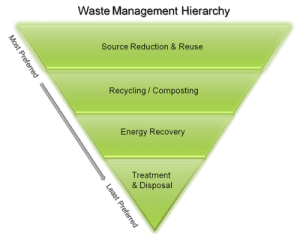
The EPA’s waste management hierarchy. Part of the article “National Overview: Facts and Figures on Materials, Wastes, and Recycling” on the website epa.gov. Courtesy of the EPA. The main reason to practice a zero-waste lifestyle is to reduce the world’s garbage. In the United States alone, the average person throws away at least 1,609 pounds of trash per year. This nation only has 5% of the world’s population, but discards 40% of its waste (Acimovic). According to one statistic, the United States and Canada are the two highest per capita generators of municipal solid waste in the world, with 2.58 kg (5.7 lbs) and 2.33 kg (5.1 lbs) of garbage generated per person per day respectively (Tiseo). The United States’s garbage has almost doubled since 1960. It grew from roughly 2.68 pounds per person per day in 1960 to 4.9 pounds per person per day in 2018. Fortunately, more trash is being recycled, composted, and combusted for energy (“National Overview”).
The focus of the zero-waste lifestyle is reducing municipal solid waste. The EPA defines municipal solid waste as “various items consumers throw away after they are used”. It includes plastic bags, tires, old clothing, and computers, but doesn’t include construction and demolition debris and municipal wastewater sludge. In the United States, the total generation of municipal solid waste was 292.4 million tons in 2018. Out of that amount, 69 million tons were recycled, 25 million tons were composted, 35 million tons were combusted for energy recovery, 146 million tons were landfilled, and 17.7 million tons were dealt with by other methods (“National Overview”).

This chart shows the amounts percentages of America’s garbage that are recycled, composted, combusted for energy recovery, landfilled, and disposed using other methods. Not all developed countries manage their trash in the same way as the United States. Sweden, for instance, only dumps 1% of its trash in landfills. Instead, Swedes recycle 47% of it and burn 52% to create energy. The energy heats 1 million homes and provides electricity to 250,000 homes. In order to encourage its citizens to recycle, the Swedish government has built recycling centers within a thousand feet of every residential area and gives discount vouchers to citizens who use recycling machines (Acimovic).

Reason #2: Plastic in the ocean
One of the best indicators of the worldwide garbage crisis is the amount of plastic that ends up in the ocean. That plastic harms marine life and pollutes sea food with dangerous chemicals. In 2020, 126.5 million kg (about 279 million lbs) of plastic waste from India ended up in the ocean, making the country the ocean’s leading plastic polluter. That much plastic would weigh the same as 250 thousand bottlenose dolphins. The United States produces about 42 billion kg of plastic waste annually, which is double the amount that India produces. However, only 2.4 million kg of American plastic waste ends up in the ocean. At first glance, that makes America look eco-friendly. The hidden reality, however, is that America exports much of its plastic waste, especially to countries with poor waste management systems. In fact, 12% of America’s exported plastic waste went to India in 2018. Plastic waste from America may end up in the ocean off of other countries (Melville).
The Ocean’s Top 10 Plastic Polluters
Country Amount of Plastic Waste in the Ocean 1 India 126.5 million kg 2 China 70.7 million kg 3 Indonesia 56.3 million kg 4 Brazil 38 million kg 5 Thailand 22.8 million kg 6 Mexico 3.5 million kg 7 Egypt 2.5 million kg 8 United States 2.4 million kg 9 Japan 1.8 million kg 10 United Kingdom 703 thousand kg (Melville)
Reason #3: Waste disposal strains relationships between countries
Although recycling plastic is helpful, it is difficult to find buyers for the plastic. Roughly one-third of American recyclables are shipped overseas, so the industry depends on a global market. Unfortunately, the market for recyclables was greatly reduced in 2018 when China no longer accepted them. Prior to China’s ban, the United States had exported roughly one-sixth of its recyclables to that country. For decades, China had recycled the world’s garbage to fuel its manufacturing boom. However, the large amounts of trash soon became a danger for China’s people and its environment. In a statement the Chinese government released to explain their ban, they described shipments of recyclable materials contained nonrecyclables that were “dirty” and “hazardous” (Profita). At least 30% of the materials sent to China were contaminated by nonrecyclables, so they were thrown away in landfills. Some likely even ended up in the ocean (Cho). All things considered, China’s ban on accepting recyclables is understandable.
After the ban took effect, the United States began to ship to Vietnam, Malaysia, and Thailand, but soon those countries closed their borders as well. Currently, the United States ships recyclables to Cambodia, Bangladesh, and Ghana since those countries have lax environmental laws and cheap labor (Fernandez). Unfortunately, the fact that our nation sends huge amounts of trash and recycling abroad strains its international relations and unfairly harms the citizens of poorer countries.
What is the solution to these problems?
I believe a zero-waste lifestyle is the best solution to plastic pollution. A zero-waste lifestyle involves boycotting trash by only using reusable items. If a person buys a single-use item, it should be either compostable or recyclable. Inspiring examples of people living zero-waste include those who collect only one jar full of trash each year. Unfortunately, boycotting waste is much easier said than done. Some zero-waste practices include drinking out of reusable mugs at coffee shops, buying secondhand furniture and clothing, bringing reusable bags to stores, and creating DIY cleaners and personal care items (Jakob). Here is a list of zero-waste tips that we can implement.
21 Zero-Waste Tips
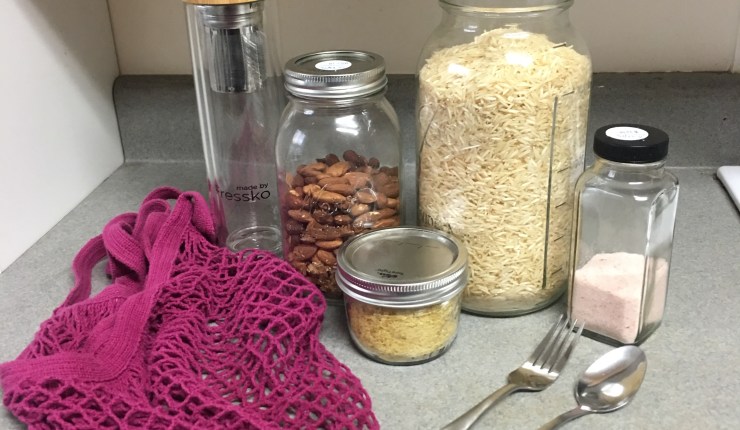
Some zero waste items, including a reusable water bottle, cutlery, mason jars, a spice jar, and a reusable grocery bag. Part of the article “Zero waste” on Wikipedia. Courtesy of Wikipedia and its creating user Hannahdobrott. - Drink out of a reusable water bottle and use reusable food containers. This could include mugs and Pyrexes for ordering out.
- Buy loose vegetables and fruits and carry them in a cloth bag.
- Compost food scraps.
- Buy secondhand items. Many household items, like furniture and clothing, can be found secondhand at thriftstores or through neighborhood Facebook groups.
- Replace paper towels with reusable clothes and napkins.
- Try shampoo and conditioner bars.
- Pack your own lunch instead of buying lunch.
- Donate items that you no longer use.
- Research zero waste personal products. There are many compostable and zero-waste products out there, and there are also many DIY recipes for items like deodorant, toothpaste, mouthwash, shampoo, and face masks.
- Borrow books from the library. If you buy books, buy e-books or secondhand books instead of new paper books.
- Recycle whatever can be recycled in your area.
- Don’t buy items that you don’t need. For instance, don’t worry about buying the latest clothing or electronics.
- Make your own food instead of buying processed food. While it may be time consuming, people can make their own hummus, breads, crackers, cookies, and other normally processed food items. Making food in large batches and freezing it may be a good idea.
- Grow your own vegetables. I’m trying to grow tomatoes and basil in pots this year, which I’m excited about.
- Eat less meat and more local produce.
- Make DIY cleaners and detergents. Cleaners can easily be made out of citrus peals.
- Buy from farmer’s markets, shops selling local food, and zero-waste stores. Many zero-waste stores have food in dispensers instead of bags.
- Give experience gifts instead of physical gifts. For instance, give a friend a gift card to a restaurant or movie theater in lieu of a physical item.
- Avoid buying balloons and other needless plastic items. You could probably find compostable or reusable decorations instead.
- Use a reusable shaving razor and reusable q-tips.
- Take school notes on the computer instead of paper notes. I’ve personally started writing outlines for my blog articles online instead of writing on paper to organize my information.
The tips above are either ones I’ve tried personally or that I’m interested in trying. Most of my ideas are from the article “90 Zero Waste Tips For Beginners” written by Merilin Vrachovska on the blog Almost Zero Waste. Here’s a link to the article if you want more ideas: www.almostzerowaste.com/simple-zero-waste-tips/.
Shampoo and Toothpastes: Zero-Waste DIY Products
Sometimes, people make their own products in order to find a zero-waste version. A zero-waste lifestyle involves coming up with innovative solutions for common problems. For instance, people with curly, thick, dry hair may not need any shampoo and can simply wash their hair with water. Others might be able to forgo shampoo by washing with a baking soda paste (Bennett). DIY toothpastes are helpful as well. Toothpaste tubes are often impossible to recycle since they are made up of fused plastic and aluminum. In addition, commercial toothpastes often contain the detergent sodium lauryl sulfate and the antimicrobial agent triclosan. Sodium lauryl sulfate is concerning since it is a potentially unsafe chemical that was originally patented as a pesticide. Triclosan, on the other hand, can cause a number of problems ranging from making bacteria resistant to antibiotics to poisoning aquatic ecosystems. In order to deal with those problems, many people purchase or make their own zero-waste toothpastes and tooth powders (Binford). Some dentists don’t recommend DIY toothpastes since they don’t contain fluoride, a mineral that strengthens teeth. However, others recommend DIY recipes made of coconut oil and baking soda. Coconut oil kills cavity-causing bacteria and boosts good bacteria in the mouth (Didonato, Burhenne), while baking soda is an alkaline that neutralizes acid in the mouth (Didonato). Dentists that recommend DIY toothpaste suggest making sure that you have fluoride from other sources, such as from your water supply (Didonato, Burhenne). Personally, I’ve experimented with a simple toothpaste recipe that involved mixing 1 tablespoon of coconut oil with ½ tablespoon of baking soda (Binford). I’ve tried it out for the past week, and as far as I can tell, it cleaned my teeth well.Conclusions
I hope you’ve enjoyed reading about the zero-waste lifestyle and the purposes behind it. Let’s protect the Earth’s future by finding ways to reduce our trash. Feel free to share this post, comment on it, or check out some of my other blog articles!
Sources
Here are the sources I used. Feel free to check them out for more information.
Acimovic, Ilija. “29 Recycling Statistics We Need to Be Aware of in 2023.” Comfy Living, Dec. 12, 2022, www.comfyliving.net/recycling-statistics/. Accessed Mar. 30, 2023.
Bennett, Hazel. “7 Zero Waste Shampoo Alternatives.” Almost Zero Waste, www.almostzerowaste.com/zero-waste-shampoo-alternatives/. Accessed Apr. 10, 2023.
Binford, Evan. “Zero Waste Toothpaste: The Growing Trend Towards No-Waste Pastes.” Utopia, May 4, 2020, www.utopia.org/guide/zero-waste-toothpaste/. Accessed Apr. 10, 2023.
Burhenne, Mark. “The Best and Worst Toothpaste Ingredients.” ask the dentist, Feb. 22, 2022, www.askthedentist.com/diy-toothpaste/. Accessed Apr. 12, 2023.
Cho, Renee. “Recycling in the U.S. Is Broken. How Do We Fix It?” Columbia Climate School, Mar. 13, 2020, www.news.climate.columbia.edu/2020/03/13/fix-recycling-america/. Accessed Apr. 13, 2023.
Didonato, Jill. “Can You DIY Your Own Toothpaste? We Asked Dentists.” Byrdie, Feb, 27, 2022, www.byrdie.com/diy-toothpaste-5095803. Accessed Apr. 12, 2023.
Fernandez, Valentina. “Where Does Your Recycling Really Go?” Dartmouth Undergraduate Journal of Science, Sept. 9, 2021, www.sites.dartmouth.edu/dujs/2021/09/09/where-does-your- recycling-really-go/. Accessed Apr. 5, 2023.
Jakob, Stefanie. “Zero-Waste Lifestyle 101: How to Lead A No-Waste Life.” Utopia, Jan. 17, 2023, www.utopia.org/guide/zero-waste-lifestyle/. Accessed Apr. 10, 2023.
Melville, Sabrina Fearon. “Ranked: The top 10 countries that dump the most plastic into the ocean.” euronews.green, Jun. 22, 2021, www.euronews.com/green/2021/06/22/ranked-the-top-10- countries-that-dump-the-most-plastic-into-the-ocean. Accessed Apr. 5, 2023.
“National Overview: Fact and Figures on Materials, Wastes and Recycling.” EPA, www.epa.gov/facts-and-figures-about-materials-waste-and-recycling/national-overview-facts- and-figures-materials. Accessed Mar. 30, 2023.
Profita, Cassandra and Jes Burns. “Recycling Chaos In U.S. As China Bans ‘Foreign Waste’.” NPR, Dec. 9, 2017, www.npr.org/2017/12/09/568797388/recycling-chaos-in-u-s-as-china-bans- foreign-waste. Accessed Apr. 5, 2023.
Tiseo, Ian. “Daily municipal solid waste generation per capita worldwide in 2018, by select country.” statista, Feb. 6, 2023, www.statista.com/statistics/689809/per-capita-msw-generation-by- country-worldwide/. Accessed Apr. 4, 2023.
Vrachovska, Merilin. “90 Zero Waste Tips For Beginners (Impactful & Easy Habits)”. Almost Zero Waste, www.almostzerowaste.com/simple-zero-waste-tips/. Accessed Apr. 10, 2023.
-
Preventing Gun Violence

Hi everyone! As you all know, the United States has a huge amount of gun violence. I wanted to shed some light on this disturbing topic.
How big is the United States’ gun violence problem?
Most of us know that the United States has a major gun violence problem, but few of us understand its extent. Here are the sobering statistics. In 2021, the United States had 692 mass shootings, and in 2020 there were 610 mass shootings. In 2021 alone, 692 people had died in mass shootings, 24,090 people died from being shot in suicides, and 20,955 people died from being shot in homicides. That same year, roughly 45,000 people died from gun fire, while about 43,000 died in car accidents. There are roughly three times the number of licensed drivers as gun owners, so the amount of gun deaths is alarming (Saldana).
Even day to day, the numbers are shocking. Every day, roughly 321 people are shot, including 22 minors. Roughly 111 of those people die, including 5 minors. Out of the people who die, most die by murder or suicide, but at least one was killed by accident, and at least one was killed by law enforcement. Out of the minors who were shot, roughly 8 were shot by accident and 8 were shot by guns left unsecured and unattended at their homes (Saldana).
The United States’ number of gun deaths makes it an outlier among the world’s developed countries. The U.S. ranks 10th out of countries with the highest gun deaths at 12.21 deaths per 100,000 people, and 1st out of countries with high incomes. By comparison, Canada only has 2.05 deaths per 100,000 people, while Mexico has 6.34 deaths per 100,000 people. (Saldana).
The United States was not always this violent. The first recognized mass shooting was in 1966. In the nine years between 1966 and 1975, there were 12 mass shootings. By 2022, roughly 4 mass shootings were happening each week (Saldana).
Why does the United States have more gun related deaths than any other developed country?
The United States likely has many gun related deaths since it has the most civilian-owned guns out of any country in the world. Although our country only has 4.4% of the world’s population, it has 42% of the civilian-owned guns in the world. At 332 million people and 393 million guns, America has 120.5 guns for every 100 people. That is because 44% of Americans have guns in their households, and the average American gun owner has eight guns. By comparison, Canadians have about a third of the guns at 34.7 guns per 100 people (Saldana).
Guns and Mental Health
One common hypothesis is that the United States has more shootings because its people have more mental health problems. However, the percentage of Americans with mental illness is roughly the same as that in other developed countries. About 16.9% of the U.S. population is mentally ill, and there are 12.2 gun related deaths per 100,000 people. In Canada, 14.9% of the population is mentally ill, but there are 2.05 deaths per 100,000 people. In Australia, about 19.3% of the population is mentally ill, but there are 1.04 deaths per 100,000 people. Most developed countries have similar statistics to Canada and Australia. Clearly, Americans’ poor mental health is not the cause of increased shootings (Saldana).Do guns keep society safer?
One prevalent theory is that places with more gun owners are safer since criminals will be afraid to cause trouble if they know that average, decent people are armed. However, that idea is not necessarily the case. In 2015, the Boston Children’s Hospital and Harvard University partnered up to study firearm data from the FBI and CDC. They found that firearm assaults were 6.8 times more common in states with the most guns versus those with the least (Moyer). Those results could either mean that people in violent areas buy more guns or that more guns cause more violence.
In addition, states with lax gun laws usually have more gun deaths. Hawaii has the least gun related deaths in the country, at 3.4 per 100,000 people. It ranks 4th on the Giffords Law Center’s list of strictest gun laws. On the other hand, Mississippi has the most gun related deaths at 28.6 deaths per 100,000 people. Mississippi ranks 45th on the Giffords Law Center’s list. Outside of Hawaii and Mississippi, states with stricter gun laws generally have less gun related deaths (Saldana).
A number of studies have been done to determine whether laws allowing concealed carrying make society safer or more dangerous. In 1997, a study by John R. Lott Jr. and David B. Mustard found that murder rates dropped 7.65% in the ten states that made it easier to carry concealed weapons. However, John Donohue conducted a similar study that found that the rate of violent crime was 13 to 15% higher after states eased permit requirements. Donohue also found that violent crime dropped drastically between 1977 and 2014 in states where gun permits were difficult to get, but only dropped a little in places where gun permits were easy to get. A third study by Donohue determined that rape rates in states with loose gun permit laws were the same or higher than rape rates in states with strict permit laws (Moyer). More civilian-owned guns does not necessarily correlate with less crime.
Some people have more nuanced views. David Hemenway is the director of the Harvard Injury Control Research Center and an expert on the public health impact of gun violence. According to him, there is no clear cause and effect between the United States’ crime rate and its number of guns. However, guns make crimes more deadly (“Do guns make us safer?”).
Do guns keep individuals safer?

According to one study, guns in the home were 4 times more likely to cause an accidental shooting, 7 times more likely to be used in an assault or homicide, and 11 times more likely to be used in a shooting than to be used for self-defense. Roughly 67% of all gun owners (and 71% of female gun owners) say that they own guns for protection (Mark). However, guns in the home can actually be a danger to oneself and one’s family. In the 1980s and 1990s, Arthur Kellermann studied how having guns in one’s home affected one’s risk of being killed by homicide and suicide. He found that if a person had one or more guns in their home, they were 70% more likely to die in a homicide and 480% more likely to die in a suicide. Kellermann and his colleagues estimated that guns in the home were 4 times more likely to cause an accidental shooting, 7 times more likely to be used in an assault or homicide, and 11 times more likely to be used in a suicide than to be used in self-defense. Kellermann’s study was criticized because his statistics may have been skewed by confounding variables. In 2003, Douglas Wiebe did a similar study and controlled for confounding variables. His statistics showed that having one or more guns in one’s home caused a 41% increase in likelihood of a homicide and a 244% increase in likeliness of a suicide (Moyer). The increased likelihood of a homicide could be due to domestic violence since 56% of intimate partner homicides are gun related (Saldana). As well as increasing homicides and suicides in homes, criminals sometimes break into people’s homes to specifically steal guns (Moyer).
Guns and Police
States with many guns are more dangerous for both police officers and anyone they might arrest. Police are more likely to be killed in states with high gun ownership. As a result, officers are more fearful and more likely to shoot anyone they perceive as a threat. According to a study by Northeastern and the Harvard T.H. Chan School of Public Health, civilians are 40% more likely to be killed by police in states with high rates of gun ownership. In fact, people are 3.6 times more likely to be killed in a police shooting in the ten states with the most guns than in the five states with the fewest guns. The less guns in a state, the safer it is for both police and anyone they might pull over or arrest (Thomsen).Are guns useful for self-defense in the case of an attack or break in?
Its unclear how many Americans use guns for self-defense annually. One study by Gary Kleck and Marc Gertz estimated that 2.5 million Americans use guns for self-defense annually, while other studies using information from the National Crime Victimization Survey only estimated that number to be 65,000 or 100,000 Americans (Moyer, “Do guns make us safer?”). The difference between the studies is likely that the National Crime Victimization Survey verified that the people it questioned were attack victims, while Kleck and Gertz’s study had a more general definition of self-defense (Moyer).
Guns can be helpful for self-defense and property defense, but its inconclusive how helpful they are. A study by Jongyeon Tark and Gary Kleck compared sixteen types of victim self-protection in crime incidents. It found that forceful tactics, including using a gun, were the best to reduce injury. Injuries following victim resistance were almost always minor. However, the study had a small sample size so its findings could be unstable (Tark). According to Hemenway, on the other hand, there is no good evidence that using a gun in self-defense reduces one’s likelihood of injury. Using a gun does reduce one’s risk of property loss, but so does using another weapon, like a mace or baseball bat (“Do guns make us safer?”).
Using a gun in self-defense is helpful in some cases, but it doesn’t always work since most people don’t have the training they need to win in a gun fight. Also, using a gun to defend property is not always the best idea because the property is not worth killing someone over (Burnett).
What about Second Amendment rights?

Photo by Sawyer Sutton on Pexels.com People have a constitutional right to life, even if it doesn’t benefit the rest of society. For instance, it would be wrong to kill a person and harvest their organs in order to save five other people. If people have a right to life, it makes sense that they would also have a right to self-defense and thus a right to bear arms (Hsiao). However, having restrictions on the right to bear arms is not a new phenomenon. Historical gun control dates back to the time of the Founding Fathers.
The Second Amendment reads “A well regulated Militia, being necessary to the security of a free State, the right of the people to keep and bear Arms, shall not be infringed” (“Constitution of the United States”). Historically, Americans at the time of the Founding Fathers believed that governments used soldiers to oppress their people. As a result, they wanted to make sure the federal government only raised armies when the country was at war. For emergencies, the United States had militias, which were made up of regular people who had their own weapons and did basic, unpaid military training. The Second Amendment comforted many Americans because they believed that if a federal army tried to take control, armed citizens would be able to defeat them (Lund and Winkler).
At the time of the Founding Fathers, there were many different state laws regulating guns. Armed citizens were required to attend mandatory musters and gun inspections. States had registries of civilian-owned guns, and officials sometimes went door to door to collect information for the registries. Laws required some people to have guns good enough for military service, while other laws prevented certain people from owning guns. For instance, the leadership at the time saw slaves and loyalists as dangerous, so they were prohibited from owning guns (Winkler). When the Fourteenth Amendment was passed, it extended the Bill of Rights’ control to the states as well, making many of the state laws unconstitutional (Lund and Winkler). However, courts still legislated according to which gun laws they found “reasonable” until recent times (Winkler).
That fact changed due to several Supreme Court cases, the most recent being New York State Rifle & Pistol Association v. Bruen. In the past, gun laws would apply if either the actions they regulated were outside the Second Amendment’s historical jurisdiction or if the law was “substantially related to the achievement of an important governmental interest”. During the Supreme Court Case Bruen, however, the Court decided that gun laws had to follow the United States’ historical tradition of firearm regulation. One justice suggested that courts use analogies to determine whether modern gun rulings are consistent with tradition (Coyle). As a result, modern gun laws now have to be compared to ones in the late 1700s.
While the Founding Fathers might not support many modern gun laws, they probably wouldn’t bat an eyelash at some modern laws, such as ones prohibiting people from owning firearms if they are under domestic violence restraining orders. If they believed it was appropriate to prevent loyalists from owning guns, it would make sense that violent offenders would be prevented from owning guns as well.
Which (if any) gun control laws are effective?
A number of studies have investigated if gun control laws are helpful. One study found that three laws were associated with less firearm deaths: background checks on gun purchases, background checks on ammunition, and firearm identification, which allows police to identify which gun a bullet came from. It estimated that background checks on gun purchases would bring down the United States’ gun related death rate from 10.3 deaths to 4.46 deaths per 100,000 people, background checks on ammunition would bring down the death rate to 1.99 deaths per 100,000 people, and firearm identification would bring down the death rate to 1.81 deaths per 100,000 people (“Gauging the Effectiveness of Gun Control Laws”).
A similar study tracked the effects of laws on gun related deaths between 1991 and 2016. It found that universal background checks dropped the homicide rate by 15%, while preventing violent criminals from owning guns dropped the homicide rate by 18%. On the other hand, “shall-issue” laws correlated with a 10% rise in the homicide rate. “Shall-issue” laws force the police to approve concealed-carry permits unless the applicant meets certain explicit criteria, while “may-issue” laws allow the police to use their discretion. In terms of laws that are tied to the suicide rate, banning certain unsafe guns creates a 6.4% reduction in the suicide rate, while not requiring a permit for concealed carrying creates a 5.1% increase in suicide (Florida).
Certain laws are helpful in combination. If a state has background checks, bans on violent offenders owning guns, and “may-issue” laws, its homicide rate reduced by roughly 36%. A state with two of the laws will have a homicide rate reduced by 13%, and a state with one will have a homicide rate reduced by 6% (Florida).
Restricting access to who has guns is more helpful than restricting access to certain types of guns (Florida).
Laws That Prevent Homicides
- background checks on gun purchases
- background checks on ammunition
- laws prohibiting violent offenders from owning guns
- firearm identification, such as microstamping or ballistic fingerprinting (“Gauging the Effectiveness of Gun Control Laws”)
- “may-issue” laws, which give police discretion over who to issue gun carrying permits to
Laws That Prevent Suicides
- “may-issue” laws
- laws banning junk guns, or guns that don’t meet certain safety requirements
Some of those laws are supported by the majority of Americans. For instance, 89% of Americans support universal background checks (Saldana). In addition, some states already have many of the laws suggested. For example, Massachusetts has background checks, “may-issue” laws, and laws prohibiting violent offenders from having weapons. That is likely one reason the state has one of the lowest homicide rates in the nation (Colarossi).
Does violence in the media add to gun violence?
Violence in media, such as movies, makes kids more aggressive (“Violence in the Media and Entertainment”). Evidence shows that watching gun violence makes it more likely for young people to be involved in it. One study on the topic covered the lives of a number of young people in Flint, Michigan from 2006 to 2016. It showed that earlier exposure to violence in video games made kids more likely to use guns or threaten to use guns (Wadley).
Another correlation between media and gun violence is that school shooters are more likely to be interested in violent media. According to a study by the U.S. Secret Service and Department of Education, half of attackers in targeted school violence were interested in violent media including books, movies, and video games. It’s unclear whether they were influenced by the media or if they were drawn to violence in the first place (“Violent video games and young people”).
While media likely makes individuals more violent, it does not always correlate with societal trends. A study by Christopher J. Ferguson at Stetson University compared the amounts of graphic violence in movies with the homicide rates between 1920 and 2011. The study couldn’t find any meaningful relationship. A second part of the study compared video game violence with youth violence between 1996 and 2011. Violence in video games increased over that time, while youth violence decreased. However, the study period was too short to draw strong conclusions (Maylie).
Guns and Hollywood
Ironically, Hollywood is one of the best gun advertisers. While gun advertisements are rare on TV or in major magazines, many guns are featured in movies and TV dramas. Guns are so common because violence in entertainment draws audiences, and guns dramatize violence and suspense. Frequently, gun companies pay movie production companies to put their products in movies. In fact, in 2010, Glock won a “lifetime achievement award for product placement” because Glocks appeared in 22 Number 1 box office films that year. Gun use in movies frequently involves main characters defending themselves and their loved ones, which makes the world seem more dangerous than it is and gives people unrealistic expectations that guns will keep them safe. In addition, people watching the movies want to use guns to emulate the powerful characters. As a result, prominent placement in high-profile films leads to big increases in sales for gun models (Bushman). Even if gun violence in movies does not make people more violent, the more guns people buy increases the risk for more accidental shootings and in-home homicides and suicides.What can people do to prevent gun violence?
- Encourage government officials to pass country wide laws that require background checks for gun and ammunition purchases, prevent violent offenders from buying guns, and enact “may-issue” laws that give police discretion over issuing gun permits (“Gauging the Effectiveness of Gun Control Laws”, Florida).
- Encourage congresspeople to allocate money for the CDC to conduct research on gun violence. Following controversy about gun violence research done by the CDC in the 1990s, Congress introduced a 1996 spending bill rider that mandated that no funding would be given to the CDC to research gun violence. The rider has been renewed every year since, and in 2011, it was extended to all Department of Health and Human Services agencies, including the NIH. As a result, the CDC and NIH can’t research guns from a public health angle (Moyer). Currently, 50 times more federal funds are spent on motor vehicle crash research than gun violence research (Thomsen), even though they kill similar numbers of Americans.
- Promote public awareness on the role Hollywood plays in gun violence, and encourage movie and video game producers to feature less guns. Other weapons, such as swords, bows, and arrows, can add suspense to media but are less likely to be used in the real world.
- People can also make personal decisions that reduce the risk of gun violence in their lives, such as storing guns safely, not keeping a gun in one’s home, or not showing children excessively violent entertainment.
Conclusions
This post covers a number of statistics on gun violence in the United States, as well as possible ways to prevent it. Hopefully we can all work together to make our country a safer place. Feel free to share this post, comment on it below, or check out some of my other blog articles!
Sources
Here are the sources I used for this article. Feel free to check them out!
Burnett, John. “Does Carrying A Pistol Make You Safer?” NPR, Apr. 12, 2016, www.npr.org/2016/04/12/473391286/does-carrying-a-pistol-make-you-safer. Accessed Feb. 16, 2023.
Bushman, Brad and Dan Romer. “Hollywood’s love of guns increases the risk of shootings- both on and off the set.” The Conversation, Oct. 22, 2021, www.theconversation.com/hollywoods-love- of-guns-increases-the-risk-of-shootings-both-on-and-off-the-set-170489. Accessed Feb. 24, 2023.
Colarossi, Jessica and Kat J. McAlpine. “The FBI and CDC Datasets Agree: Who Has Guns – Not Which Guns – Linked to Murder Rates.” Boston University: The Brink, Aug. 6, 2019, www.bu.edu/articles/2019/state-gun-laws-that-reduce-gun-deaths/. Accessed Feb. 23, 2023.
“Constitution of the United States: Second Amendment.” CONGRESS.GOV, www.constitution.congress.gov/constitution/amendment-2/. Accessed Feb. 21, 2023.
Coyle, Marcia. “Analysis: How a Supreme Court ruling led to the overturning of a guns and domestic violence law.” PBS News Hour, www.pbs.org/newshour/politics/analysis-how-a-supreme-court- ruling-led-to-the-overturning-of-a-guns-and-domestic-violence-law. Accessed Feb. 22, 2023.
“Do guns make us safer? Science suggests no.” Harvard T. H. Chan School of Public Health: News, 2016, www.hsph.harvard.edu/news/hsph-in-the-news/do-guns-make-us-safer-science-suggests- no/. Accessed Feb. 14, 2023.
Florida, Richard and Nicole Javorsky. “The 3 Gun-Control Laws That Work Best in the U.S.” Bloomberg, Apr. 5, 2019, www.bloomberg.com/news/articles/2019-04-05/the-3-gun-control- laws-that-work-best-in-the-u-s. Accessed Feb. 23, 2023.
“Gauging the Effectiveness of Gun Control Laws.” Columbia Law School, Mar. 10, 2016, www.law.columbia.edu/news/archive/gauging-effectiveness-gun-control-laws. Accessed Feb. 23, 2023.
Hsiao, Timothy. “Why Americans Have A Right To Own Guns Even If That Makes Us Less Safe.” The Federalist, Feb. 27, 2018, www.thefederalist.com/2018/02/27/americans-right-guns-even- makes-us-less-safe/. Accessed Feb. 16, 2023.
Lund, Nelson and Adam Winkler. “The Second Amendment: Common Interpretation.” National Constitution Center, www.constitutioncenter.org/the-constitution/amendments/amendment- ii/interpretations/99. Accessed Feb. 21, 2023.
Maylie, Devon. “Violent media and real-world behavior: Historical data and recent trends.” The Journalist’s Resource, Feb. 18, 2015, www.journalistsresource.org/criminal-justice/violent- media-real-world-behavior-historical-data-recent-trends/. Accessed Feb. 23, 2023.
Moyer, Melinda Wenner. “More Guns Do Not Stop More Crimes, Evidence Shows.” Scientific American, Oct. 1, 2017, www.scientificamerican.com/article/more-guns-do-not-stop-more- crimes-evidence-shows/. Accessed Feb. 14, 2023.
Saldana, Dave. “Guns in America: 16 Charts You Need to See.” Reader’s Digest, Nov. 7, 2022, www.rd.com/article/gun-violence-statistics/. Accessed Feb. 10, 2023.
Tark, Jongyeon and Gary Kleck. “Resisting Crime: The Effects of Victim Action on the Outcomes of Crimes: Abstract.” Wiley Online Library, Mar. 7, 2006, www.onlinelibrary.wiley.com/doi/abs/10.1111/j.1745-9125.2004.tb00539.x. Accessed Feb. 16, 2023.
Thomsen, Ian. “Does having a gun at home really make you safer?” Northeastern Global News, Feb. 13, 2019, www.news.northeastern.edu/2019/02/13/does-having-a-gun-at-home-really-make- you-safer. Accessed Mar. 13, 2023.
Thomsen, Ian. “Do more guns lead to more fatal police shootings?” Northeastern Global News, Oct. 26, 2018, www.news.northeastern.edu/2018/10/26/do-more-guns-lead-to-more-fatal-police- shootings/. Accessed Feb. 22, 2023.
“Violence in the Media and Entertainment.” AAFP, www.aafp.org/about/policies/all/violence-media- entertainment.html. Accessed Feb. 23, 2023.
“Violent video games and young people: Experts are divided about the potential harm, but agree on some steps parents can take to protect children.” Harvard Health Publishing: Harvard Medical School, Oct. 1, 2010, www.health.harvard.edu/newsletter_article/violent-video-games-and- young-people. Accessed Feb. 24, 2023.
Wadley, Jared. “Childhood exposure to gun violence increases risk of violent behavior as adults.” University of Michigan News, Jul. 20, 2021, www.news.umich.edu/childhood-exposure-to-gun- violence-increases-risk-of-violent-behavior-as-adults/. Accessed Feb. 24, 2023.
Winkler, Adam. “The Reasonable Right to Bear Arms.” National Constitution Center, www.constitutioncenter.org/the-constitution/amendments/amendment-ii/interpretations/99. Accessed Feb. 21, 2023.
-
Why conserve apex predators?

Hi everyone! You may have read articles about charismatic predators, such as lions and tigers, being on the verge of extinction. In addition, you may have heard about the controversy over reintroducing wolves to Yellowstone National Park in the 1990s. If you’re like me, you’ve probably wondered if the decreasing numbers of predators is a devastating loss to ecosystems or if their demise simply makes the world a safer place for humans. I wanted to do a post on this fascinating topic.
Predators’ Roles in Ecosystems

A sea otter eating a purple sea urchin. Part of the article “Sea otter” on Wikipedia. Courtesy of Wikipedia and Matt Knoth. Predators’ main role in ecosystems is to rule from the top down, as opposed to producers, who rule from the bottom up. Apex predators keep other consumers in check so they don’t eat producers to extinction. In fact, if an ecosystem’s apex predators are removed, it could cause a trophic cascade, or a major series of changes to the rest of the food web. It could even cause an ecosystem to collapse. For example, humans hunting sea otters decimated kelp forests around the Aleutian Islands. Otters normally eat sea urchins, which feed on kelp. When the otters went extinct in certain areas, urchins multiplied and ate all the kelp. When the otters eventually returned, they reduced the number of sea urchins, allowing “luxuriant” regrowth of kelp. A similar situation happened in Venezuela. In the 1980s, a new dam flooded a valley, creating islands. Before the flood, apex predators like jaguars, mountain lions, harpy eagles, and armadillos left the area. As a result, the islands turned into a hellscape. Howler monkeys living there multiplied out of control and then went mad. In order to defend themselves from being eaten by the monkeys, plants grew thorns and increased their toxicity. Leaf-cutter ants were no longer being preyed on by armadillos, so they carried all the leaves on the islands into their holes, starving the soil of nutrients. Clearly, the ecosystems of the islands collapsed without apex predators (Fraser).
What are some of apex predators’ important roles in ecosystems?
- Apex predators reduce populations of herbivores, preventing them from overeating and decimating ecosystems. For instance, wolves reduce populations of elk, which prevent the elk from eating too many saplings. As a result, more saplings grow to maturity, providing habitat for other animals and soaking up water to prevent floods (“The Importance of Apex Predators for a Healthy Ecosystem”). Ecosystems have delicate checks and balances between predators and prey that likely evolved over millions of years (Dolph). If those balances are upset, it could upend an entire ecosystem.
- As well as eating herbivores, apex predators also eat mesopredators, keeping those populations in check. Mesopredators are mid sized predators like cats and raccoons that are in middle trophic levels. If all the apex predators in an ecosystem die out, mesopredators take over and run rampant. As an illustration, a reduction in lion and leopard populations in Ghana caused olive baboon populations to soar. The baboons are now wildly attacking livestock, damaging crops, and spreading intestinal parasites (Fraser).
- Ironically, the best way apex predators keep herbivores and mesopredators in check is not by eating them, but by creating landscapes of fear that keep them moving. On their own, elk herds will stay in one place and eat all the vegetation there. However, if there are wolves nearby, the elk will browse and then keep moving to look for cover. They will leave small plants and grasses for smaller herbivores and eat less saplings, which ultimately reduces flooding (“The Importance of Apex Predators for a Healthy Ecosystem”). The same principle occurs with mesopredators. On British Columbia’s Gulf Islands, raccoons were eating songbirds, intertidal crabs, and certain fish to near extinction. The raccoons were unafraid since the last large carnivores on the islands had been killed a century before. Then, a research team set up speakers that played dog vocalizations along the shoreline. When raccoons went to those areas to feed, they either left quickly or reduced their foraging. The raccoons’ feeding time was so reduced that the songbird, crab, and fish populations were able to rebound (Mandel). The fear that hearing dogs produced in the raccoons was enough to keep them in check.
- Apex predators can help prey populations by weeding out slow, weak, and diseased animals, which increases the health of the prey populations as a whole (“The Importance of Apex Predators for a Healthy Ecosystem”).
- Apex predators can increase the biodiversity of ecosystems. When wolves were reintroduced to Yellowstone in the 1990s, they controlled the park’s elk, which meant that the elk ate less saplings. As a result, willows and other trees grew on the banks of the streams, cooling the water. The cool water allowed trout and beavers to return for the first time after the vegetation had been decimated by elk. The beavers built dams, which created new ponds. Soon, amphibians and songbirds moved in to enjoy the ponds. The reintroduction of wolves ultimately led to an increase in biodiversity across the whole ecosystem (Fraser).

A jumping spider capturing a
grasshopper. Part of the article
“Jumping spider” on Wikipedia.
Courtesy of Wikipedia and
Jee & Rani Nature Photography.Creepy Crawlies: How Spiders Effect the Vegetation In Their Areas
Spiders are tiny apex predators that prey on insects. Whether they are active hunters or ambush hunters determines the composition of plant communities and the nitrogen levels in their areas. If an area has spiders that actively hunt, they reduce its grasshopper density. As a result, grass and goldenrod dominate since they are being eaten by less grasshoppers. That increases the availability of nitrogen in the area. On the other hand, if an area has spider species that ambush hunt, they will simply force grasshoppers to shelter in goldenrod instead of grass. That leads to a diverse plant community with less available nitrogen (Fraser). Spiders may be small, but they exert impressive control over their ecosystems.What about dangerous apex predators?
Sometimes conserving apex predators can be controversial since those predators are seen as menaces to humans. Sharks are one type of apex predator that are portrayed as deadly monsters in popular culture. However, sharks are actually beneficial to both ocean ecosystems and humans.
What are the benefits of sharks in ocean ecosystems?
Surprisingly, sharks are some of the most vital organisms for the health of ocean ecosystems. There are over 500 species of sharks worldwide. Each species has a different diet, set of behaviors, and role in its ecosystem. Some of sharks’ most important roles are preserving coral reefs, bivalves, and seagrass meadows.
Coral reefs contain one quarter of the world’s marine life. In reef food webs, sharks eat predatory fish like groupers, which eat herbivorous fish that feed on algae. If an area has few sharks, there will be an explosion of groupers, which in turn will eat most of the herbivorous fish. The lack of herbivorous fish will cause an explosion of algae. If the algae in a reef overgrows too much, it will suffocate the corals and kill the reef. That is currently a major problem in Jamaica, where a drop in shark populations has led to the decimation of the island’s coral reefs (“How Do Sharks Help the Ecosystem?”).
Sharks also protect bivalves. Bivalves, such as mussels, scallops, and clams, act as the ocean’s filtration system. They filter phytoplankton out of the water to eat and while doing so, clean the ocean. Bivalves are eaten by Cownose rays. Sharks normally hunt the rays, but if there are no sharks in an area, the rays devour the bivalve population. That leaves the area with no water purification (“How Do Sharks Help the Ecosystem?”).
Finally, sharks preserve seagrass meadows by keeping the turtles and dugongs that eat seagrass moving along. Seagrass meadows store huge amounts of carbon that would otherwise be released into the atmosphere or ocean. As well as accelerating climate change in the atmosphere, carbon dissolved in the ocean makes the water more acidic and harms the organisms that live there (“How Do Sharks Help the Ecosystem?”).

A zebra shark. Part of the article “Carpet shark” on Wikipedia. Courtesy of Wikipedia and Thesupermat. Are sharks dangerous to humans?
Due to the portrayal of sharks in popular culture, people see them as major threats. However, sharks attacks in real life are rare. In 2021, 112 bites on humans were reported worldwide. Nine of those cases were fatal (“International Shark Attack File”). On average, there are about six recorded fatalities from shark attacks per year (Edwards). There may also be a number of unrecorded shark fatalities in developing countries. However, considering that there are 1 billion sharks and 8 billion people worldwide (“How Many Sharks Are In The World?”), six recorded fatalities is fairly small. Fatality rates from shark bites have been declining for decades due to increased public awareness, improved medical treatment, and better beach safety protocols (“International Shark Attack File”). While shark attacks are rare, sharks are dangerous animals so people should educate themselves on shark safety and beach protocols before they swim in the ocean or take part in water sports.
While sharks are rarely a danger to humans, humans are a massive danger to sharks. Roughly 100 million sharks are killed by humans each year (Sen), which is one tenth of the world’s current shark population (“How Many Sharks Are In The World?”). As a result, an estimated 25% of shark and ray species are threatened with extinction. Sharks are killed for a number of reasons. One of the main ways humans kill sharks is shark finning. Shark fins are used in shark fin soup, a delicacy in some places. Unfortunately, shark finning is very cruel. After fishers catch a shark, they will usually saw its fins off while it is still alive. Then, they will toss it overboard. The live shark cannot swim without its fins, so it sinks and drowns. Shark finning is illegal in 70 countries and regional bodies, but it is not illegal globally. Many other sharks are killed from being caught as bycatch. Bycatch are marine animals that are accidently caught in fishing nets. Estimated tens of millions of sharks are killed each year from being bycatch. A third cause of the decline of the shark population is nursery and habitat destruction from coastal development and destruction of coral reefs and mangrove swamps (Sen). People need to remember that the ocean is the sharks’ home. When humans enter the water, they are doing so at their own risk. A decline in shark populations should not be seen as a benefit to humans, but rather a danger to aquatic ecosystems.
Sharks are actually very helpful to humans. Shark related tourism is a boon to countries’ economies. It contributes about 113.8 million USD to the economy of the Bahamas annually (Sen), as well as 42.2 million USD to Fiji (Sen) and 25.5 million USD to Australia. Reef related tourism is an even bigger money maker, with Australia receiving billions of dollars from it every year (“How Do Sharks Help the Ecosystem?”). Sharks also protect types of seafood that humans eat. A decrease in sharks along the eastern seaboard led to an explosion of rays that killed an old scallop fishery. If sharks had been protected in the area, the fishery would have remained intact (Fraser).
The best ways for humans to protect sharks are only buying certified sustainable seafood, avoiding shark meat and products, and encouraging the creation of Marine Protected Areas along coastlines. Shark products to avoid include liver oil, jaws, teeth, shark leather, and flake, which is shark meat (Sen).
Human Deaths Caused by Apex Land Predators Versus Other Animals
This chart compares the numbers of human deaths caused by wolves and lions versus the numbers of deaths caused by other animals.
Animal Number of Humans It Kills Annually mosquitoes 725,000* humans 475,000* wolves 2–10 *, ** deer 120 in the United States (mainly through car accidents)* lions 200*** hippopotamuses 3,000*** African elephants 500*** Cape Buffalo 200*** * is the source Cutolo, ** is the source “ARE WOLVES DANGEROUS TO HUMANS?, and *** is the source “Most Dangerous Animals in Africa” Just because an animal is an apex predator does not mean it is more dangerous than some herbivores. Hippopotamuses, which are a prey of lions, actually kill 15 times more humans than lions themselves. The most dangerous animals in the world are mosquitoes and humans.
Conclusion
This post covered the benefits of conserving apex predators and also statistics on how dangerous certain predators are to humans. I find this information fascinating and want to spread more awareness about the benefits of apex predators in the future. Feel free to share this post, comment on it below, or check out some of my other blog articles!
Sources
Here are the sources I used for this post. Feel free to check them out!
“ARE WOLVES DANGEROUS TO HUMANS? The risks associated with a wolf attacking a human are ‘above zero, but far too low to calculate,’ a new report says.” International Wolf Center, http://www.wolf.org/wolf-info/factsvsfiction/are-wolves-dangerous-to-humans/. Accessed Jan. 25, 2023.
Cutolo, Morgan. “22 Animals That Are Deadlier Than Sharks.” Reader’s Digest, Juliana LaBianca, Nov. 28, 2022, www.rd.com/list/animals-that-are-deadlier-than-sharks/. Accessed Jan. 25, 2023.
Dolph, Mara. “What Happens When the Top Predator Is Removed From an Ecosystem?” seattle pi, http://www.education.seattlepi.com/happens-top-predator-removed-ecosystem-3496.html. Accessed Jan. 23, 2023.
Edwards, Charlotte. “KILLER INSTINCT: World’s deadliest animals ranked by number of humans killed – and snails are number 5 on list.” The Sun, www.thesun.co.uk/tech/10450075/worlds- deadliest-animals-ranked. Accessed Jan. 25, 2023.
Fraser, Caroline. “The Crucial Role of Predators: A New Perspective on Ecology.” Yale Environment 360, Yale School of the Environment, Sept. 15, 2011, http://www.e360.yale.edu/features/the_crucial_role_of_predators_a_new_perspective_on_ecology. Accessed Jan. 20, 2023.
“How Do Sharks Help The Ecosystem?” Our Endangered World, Nov. 22, 2022, www.ourendangeredworld.com/species/how-do-sharks-help-the-ecosystem/. Accessed Jan. 24, 2023.
“How Many Sharks Are In The World?” NW: NMK WORLD, Jul. 7, 2022, www.nmk.world/how-many- sharks-are-in-the-world-148923/. Accessed Jan. 25, 2023.
“International Shark Attack File: Yearly Worldwide Shark Attack Summary: The ISAF 2021 shark attack report.” Florida Museum, www.floridamuseum.ufl.edu/shark-attacks/yearly-worldwide- summary/. Accessed Jan. 25, 2023.
Mandel, Charles. “How top predators enforce balance in the ecosystem.” Canada’s National Observer, Feb. 23, 2016, www.nationalobserver.com/2016/02/23/news/fear-factor-how-top-predators- enforce-balance-ecosystem. Accessed Jan. 23, 2023.
“Most Dangerous Animals In Africa: the 10 deadliest animals in africa.” Safaris Africana, www.safarisafricana.com/most-dangerous-animals-africa/. Accessed Jan. 28, 2023.
Sen, Ria. “Sharks: Friends not foes!” IUCN, Nov. 5, 2018, www.iucn.org/news/asia/201811/sharks- friends-not-foes. Accessed Jan. 25, 2023.
“The Importance of Apex Predators for a Healthy Ecosystem.” greener ideal, Jun. 11, 2010, www.greenerideal.com/news/environment/7066-the-importance-of-apex-predators/. Accessed Jan. 23, 2023.
-
Highlights of 2022

Hi everyone! I know its easy to be anxious about the earth. While it is important to be informed and care about the environment, too much anxiety is counterproductive. I wanted to take the time to inspire you with positive environmental news from 2022.

This is a photo of the preamplifiers of the National Ignition Facility at the Lawrence Livermore National Laboratory. They increase the energy of the laser beams as they head toward the target chamber where nuclear fusion takes place. Image courtesy of Wikipedia and the Lawrence Livermore National Laboratory. Nuclear Fusion Breakthrough
On December 5, scientists at the Lawrence Livermore National Laboratory in California had a breakthrough in nuclear fusion energy production. For the first time ever, they set up a nuclear fusion reaction that produced more energy than it took to create. To catalyze the reaction, the laboratory’s laser complex shot 192 lasers at a tiny capsule containing one tritium isotope and one deuterium isotope, both of which are isotopes of hydrogen. The isotopes vaporized, releasing a huge amount of energy. The experiment had been tried many times before, but the energy input of the lasers had always exceeded the output of the fusion. On December 5, however, the isotopes were held in a thicker capsule, which made them hot and dense enough that they fused and released more energy than the lasers expended. The lasers hit the isotopes with roughly two megajoules of energy, and the fusion produced about three megajoules, generating a gain of 1.5 (“Nuclear Fusion Breakthrough: The Future of Clean, Limitless Energy”). That energy gain would be enough to boil 2.5 gallons of water (Nilsen). While that is not a lot, it shows that nuclear fusion can be a viable energy source.
Why is nuclear fusion special?
Nuclear fusion would make an excellent energy source since it runs off easily accessible hydrogen and produces efficient, carbon-free energy. It is much safer than nuclear fission, which is used in current nuclear power plants. Nuclear fission splits atoms to produce energy and poisonous waste, while fusion fuses atoms to yield energy and harmless byproducts (“Nuclear Fusion Breakthrough: The Future of Clean, Limitless Energy”). The atoms being fused are deuterium and tritium, which are isotopes of hydrogen. As an illustration of how efficient nuclear fusion is, if a little tritium was fused with the amount of deuterium from a glass of water, the energy from the reaction would power a house for a year (Nilsen, Ella and Rene Marsh). The byproducts of nuclear fusion are helium nuclei and high energy neutrons (“DOE Explains… Nuclear Fusion Reactions”).Dr. Kim Budil, the director of the Lawrence Livermore National Laboratory, predicts that fusion power plants will be built “with a few decades of research and investment” (“Nuclear Fusion Breakthrough: The Future of Clean, Limitless Energy”). Nuclear fusion power plants might even take off as quickly as nuclear fission power plants did. In 1942, the first nuclear fission reactor ran for five minutes in Chicago. Fifteen years later, the first nuclear power plant was installed in Pennsylvania (Nilsen). In addition, magnetic nuclear fusion is being explored as well as fusion caused by lasers. Magnetic fusion involves tokamaks, or doughnut shaped devices that use magnets to squeeze plasma into small shapes (“Nuclear Fusion Breakthrough: The Future of Clean, Limitless Energy”).

Photo by Pixabay on Pexels.com 2022 Has Seen A Huge Increase in Renewable Energy
This past year has seen a major increase in renewable energy. The world’s electricity demand rose by about 3% since 2021, but solar, wind, and hydroelectric power met the additional demand for the first half of 2022. That reduced carbon emissions by 230 million metric tons, or the equivalent of 49 million gas powered cars (“Renewables have saved 230 million tonnes of CO2 emissions so far in 2022”).
The overall increases in renewable energy are likely due to changes in the United States and Europe. Solar and wind have grown 58% in the United States since 2019. As a result, 2022 marked the second year that renewables produced more energy for the country than coal, satisfying about 22% of its energy usage (“Renewables to produce more energy than coal for the first time this year”). European countries have been taking even more drastic steps. Portugal, Denmark, and Austria have goals to be powered solely by solar, wind, and hydroelectric in 2030, while the Netherlands aims to be powered solely by those renewables plus nuclear. (“These EU countries are aiming for 100% clean power by 2030”). Although Greece is not aiming to be 100% renewable in 2030, it made history on October 7 by being solely run on renewable energy for five hours (“Major milestone for Greek energy as renewables power 100% of electricity demand”). Renewables are starting to become a major provider of the world’s electricity.

Photo by Rudolf Jakkel on Pexels.com Millions of Trees Are Being Planted for Reforestation Efforts
This past year, there have been several massive reforestation projects. Forest cover is important since trees produce oxygen and absorb carbon dioxide, prevent flooding by holding water, and keep areas moist through transpiration. In the United States, the federal National Forest Foundation planted over eight million trees (“2022 National Forest Foundation Year in Review”). Some of the trees are in forests being restored after wildfires, such as in Oregon’s Willamette National Forest, or after being destroyed by beetles, such as in Grand Mesa National Forest in Colorado. Others have not experienced natural disasters but need more trees to be healthy, thriving ecosystems (Perez-Watkins). In addition, a charity called One Tree Planted has been planting trees and vegetation all over the world. While statistics have not been released for the nonprofit’s work in 2022, in 2021 the organization’s volunteers planted about 25,588,232 trees through 166 projects in 42 countries (“Our 2021 Planting Report”). During autumn 2022, One Tree Planted supported events in 29 countries to plant 39,558 trees and 6,144 shrubs. Some countries served by the organization include Columbia, Tanzania, Thailand, and the United States (Weeden).
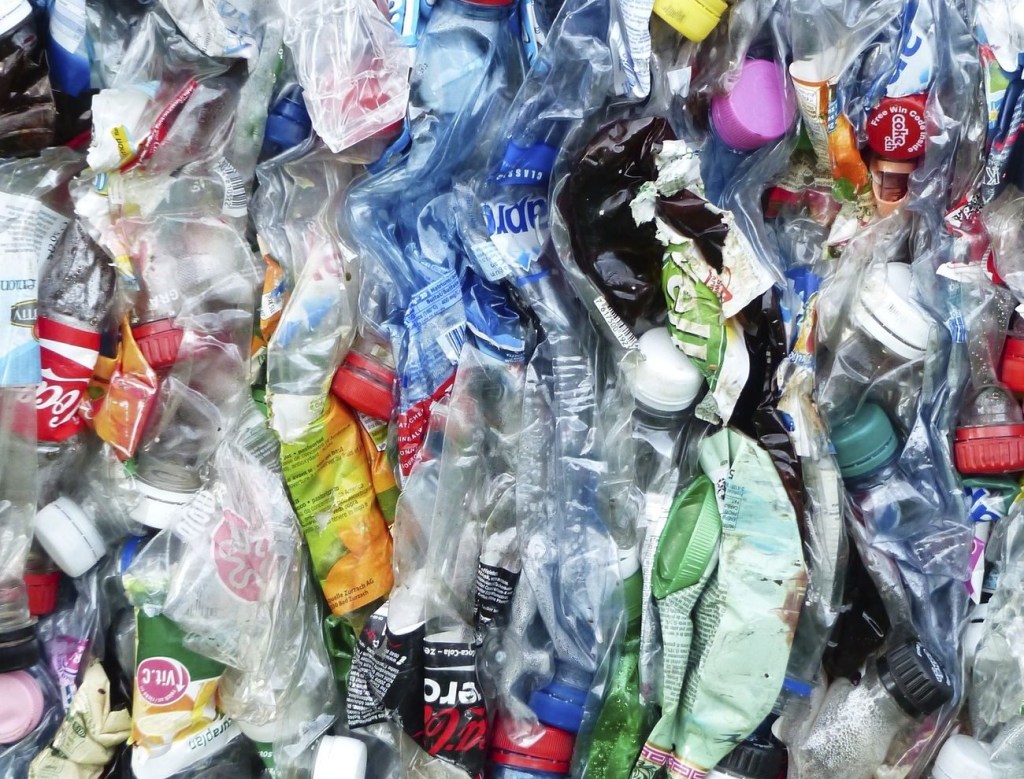
States and Countries are Cutting Down Single Use Plastics
Multiple parts of the world have been reducing the use of single-use plastics and replacing them with either biodegradable packaging or reusable items. In 2022, California passed a law demanding a 25% drop in single-use plastics in the state by 2032. It also set a goal for 30% of plastic items bought and sold in California to be recyclable by 2028, created a pollution mitigation fund paid by plastic companies, and set strictly enforced criteria for polystyrene recycling that could lead to a ban on the material. California’s decision to cut down on plastics should reduce worldwide pollution since California is a major source of it (Anguiano).
The UK and the European Commission are taking even more extreme measures to reduce single-use plastics. Single-use plastic plates, cutlery, balloon sticks, and some types of polystyrene cups will be phased out and eventually banned in the UK. The UK government intends to replace the plastics with biodegradable alternatives (“Single-use plastic items to be banned in England – reports”). The European Commission, on the other hand, wants to make more items reusable. For instance, they decreed that 20% of takeaway drink cups in their domain would be reusable by 2030 and 80% would be reusable by 2040. As a result, McDonald’s France and other European companies are testing out reusable packaging (“This reusable McDonald’s packaging went viral”).
Seaweed Packing
Scientists are doing their part by developing new types of biodegradable packaging. One popular option is seaweed. A number of startup companies have begun selling seaweed products, including bags, cups, trays, sauce packets, takeout boxes, pipettes, drinking straws, vegan leather, “plastic” films, and waterproof cardboard coatings (“10 Seaweed Packaging Startups You Need to Know”). In 2022, researchers from Flinders University in Australia partnered with a German biomaterials developer to specifically create grease proof wrappings. The packaging is effective and safer than grease proof paper, which contains plastic and sometimes dangerous chemicals like PFASs (“Your burger could soon come wrapped in packaging made from seaweed”).Efficient Sea Salt Batteries Could Replace Lithium Batteries
Batteries are necessary to everything from wall clocks to smart phones to electric cars. As wind and solar power take off, batteries are needed to store their intermittent electricity. Many batteries are built with rare metals such as lithium, graphite, and cobalt. Since lithium is the main metal used in batteries, the European Union alone might need 18 times more lithium by 2030 to meet their renewable energy goals. Unfortunately, lithium is expensive (“’Significant breakthrough’: This new salt sea battery has four times the capacity of lithium”), and its mining causes a number of environmental problems, including water shortages and air contamination (Campbell). In order to combat those problems, scientists at the University of Sydney invented a new battery that runs on sodium sulfur, or molten salt processed from sea water. It stores four times the energy of a lithium battery and is much cheaper. According to the battery’s inventors, it also has an “ultra-long life at room temperature” (“’Significant breakthrough’: This new salt sea battery has four times the capacity of lithium”). Sea salt batteries are a welcome alternative to lithium ones.
Humpback whale by National Park Service is licensed under CC-CC0 1.0 Humpback Whales No Longer Threatened in Australia
A final piece of good news is that there is a large community of humpback whales in the waters near Australia! Humpbacks were removed from Australia’s threatened species list in 2022. They were originally put on the list since their numbers had decreased to about 1,500 whales at the height of the whaling industry. Now, there are about 40,000 whales in the waters near Australia. The whales are still protected by a number of international and domestic laws, including statutes against whaling (Wahlquist).
Conclusions
This article covered six positive environmental developments from 2022. I hope you are encouraged by this information as much as I am! Feel free to comment below, share this post, or check out some of my other blog articles.
Wishing you a happy 2023!
Sources
Here are my sources for this post. Feel free to check them out! A few of these sources have the same author, so they are cited in the article by their title instead of their author’s name.
Anguiano, Dani. “California passes first sweeping US law to reduce single-use plastic.” The Guardian, Jun. 30, 2022, www.theguardian.com/us-news/2022/jun/30/california-single-use-plastic-reduce- law-gavin-newsom. Accessed Dec. 20, 2022.
Campbell, Maeve. “In pictures: South America’s lithium fields reveal the dark side of our electric future.” euronews.green, Nov. 21, 2022, www.euronews.com/green/2022/02/01/south-america- s-lithium-fields-reveal-the-dark-side-of-our-electric-future. Accessed Dec. 19, 2022.
“DOE Explains… Nuclear Fusion Reactions.” Energy.gov: Office of Science, http://www.energy.gov/science/doe-explainsnuclear-fusion-reactions. Accessed Dec. 27, 2022.
Elton, Charlotte. “’Significant breakthrough’: This new sea salt battery has four times the capacity of lithium.” euronews.green, Dec. 14, 2022, http://www.euronews.com/green/2022/12/13/significant- breakthrough-this-new-sea-salt-battery-has-4-times-the-capacity-of-lithium. Accessed Dec. 19, 2022.
Elton, Charlotte. “Your burger could soon come wrapped in packing made from seaweed.” euronews.green, Oct. 24, 2022, www.euronews.com/green/2022/10/23/your-burger-could-soon- come-wrapped-in-packing-made-from-seaweed. Accessed Dec. 19, 2022.
Frost, Rosie. “Renewables have saved 230 million tonnes of CO2 emissions so far in 2022.” euronews.green, Oct. 10, 2022, www.euronews.com/green/2022/10/06/rise-of-renewable- energy-has-prevented-230-million-tonnes-of-co2-emissions-so-far-this-yea. Accessed Dec. 19, 2022.
Frost, Rosie. “Renewables to produce more energy than coal in the US for the first time this year.” euronews.green, Nov. 24, 2022, www.euronews.com/green/2022/11/24/renewables-to-produce- more-energy-than-coal-in-the-us-for-the-first-time-this-year. Accessed Dec. 19, 2022.
Frost, Rosie. “These EU countries are aiming for 100 per cent clean power by 2030.” euronews.green, Oct. 18, 2022, www.euronews.com/green/2022/10/17/these-eu-countries-are-aiming-for-100- per-cent-clean-power-by-2030. Accessed Dec. 19, 2022.
Frost, Rosie. “This reusable McDonald’s packaging went viral: Could it be the future in Europe?” euronews.green, Nov. 30, 2022, www.euronews.com/green/2022/11/30/this-reusable- mcdonalds-packaging-went-viral-could-it-be-the-future-in-europe. Accessed Dec. 19, 2022.
“Major milestone for Greek energy as renewables power 100% of electricity demand.” euronews.green with Reuters, Oct. 11, 2022, www.euronews.com/green/2022/10/11/major-milestone-for-greek- energy-as-renewables-power-100-of-electricity-demand. Accessed Dec. 19, 2022.
Nilsen, Ella. “US officials announce nuclear energy breakthrough: Why a net gain in energy matters.” CNN, Dec. 13, 2022, www.cnn.com/us/live-news/nuclear-fusion-reaction-us-announcement-12- 13-22/index.html. Accessed Dec. 16, 2022.
Nilsen, Ella and Rene Marsh. “US officials announce nuclear fusion breakthrough: What you need to know about today’s nuclear fusion announcement – and what comes next.” CNN, Dec. 13, 2022, www.cnn.com/us/live-news/nuclear-fusion-reaction-us-announcement-12-13-22/index.html. Accessed Dec. 16, 2022.
“Nuclear Fusion Breakthrough: The Future of Clean, Limitless Energy.” Forbes, Q.ai, Dec. 14, 2022, www.forbes.com/sites/qai/2022/12/14/nuclear-fusion-breakthrough-the-future-of-clean- limitless-energy/. Accessed Dec. 16, 2022.
“Our 2021 Planting Report: Behind the Scenes of Planting 23 Million Trees Across the Globe: Our Impact in 2021.” One Tree Planted, onetreeplanted.org/pages/2021-recap. Accessed Dec. 27, 2022.
Perez-Watkins, Monica. “2022 Tree Planting Projects.” National Forest Foundation, www.nationalforests.org/blog/2022-tree-planting-projects. Accessed Dec. 20, 2022.
“Single-use plastic items to be banned in England – reports.” The Guardian, Dec. 13, 2022, www.theguardian.com/environment/2022/dec/13/single-use-plastic-items-to-be-banned-in- england-reports. Accessed Dec. 20, 2022.
“10 Seaweed Packaging Startups You Need to Know.” sourcegreen, www.sourcegreen.co/food- packaging/10-seaweed-packaging-startups-algae/. Accessed Dec. 31, 2022.
“2022 National Forest Foundation Year in Review.” National Forest Foundation, www.nationalforest.org/2022-nff-year-in-review. Accessed Dec. 31, 2022.
Wahlquist, Calla. “Humpback whales removed from Australia’s threatened species list but feeding grounds still at risk.” The Guardian, Feb. 25, 2022, www.theguardian.com/environment/2022/feb/26/humpback-whales-removed-from-australias- threatened-species-list-but-feeding-grounds-still-at-risk. Accessed Dec. 20, 2022.
Weeden, Meaghan. “Plant a Tree Day 2022: Planting Trees, Growing Community: Community Reforestation for Global Impact: Plant a Tree Day 2022.” One Tree Planted, Nov. 3, 2022, onetreeplanted.org/blogs/stories/plant-a-tree-day-2022. Accessed Dec. 27, 2022.
-
Powering the Future: The Reality of Fuel Cells
Hi everyone! I have an interest in fuel cells, so I decided to write a post on them. Fuel cells are a hot topic right now and are being investigated as an environmental option to power cars, trucks, buildings, and planes. They run on hydrogen, so about a year ago, the United States government set goals to establish hydrogen hubs across the country and reduce the cost of green hydrogen to 1 U.S. dollar per kilogram (Silverstein). Fuel cells and fuel cell vehicles are specialized technology that will continue to become more prevalent in the future.
What are fuel cells?
Although fuel cells are a hot topic, they are not a new one. The first fuel cells were built around 1842 by William Grove, who managed to both generate an electric current and produce water through a reaction involving hydrogen and oxygen. Grove’s fuel cells involved series circuits of platinum electrodes. Each “cell” of the series had two platinum electrodes, one in a tube filled with oxygen and one in a tube filled with hydrogen. The bottoms of the tubes and electrodes were dipped in a dilute sulfuric acid solution, which conducted current between the electrodes (Poffenberger).
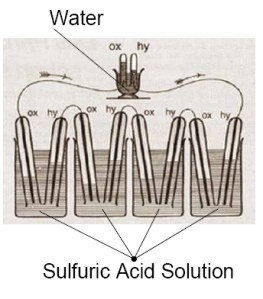
An image of Grove’s fuel cell. Courtesy of Wikipedia. Fuel cells have changed a bit over the past 180 years, but the basic idea is still the same. All fuel cells have a negative electrode, or anode, and a positive electrode, or cathode, that are separated by an electrolyte. A fuel, like hydrogen, is fed to the anode, while air is fed to the cathode (“Fuel Cell Basics”). A catalyst at the anode separates hydrogen into its protons and electrons, which each take a different path to the cathode. The electrons take an external circuit, which creates an energy flow, while the protons travel directly through the electrolyte. When both the electrons and protons reach the cathode, they react with the oxygen there to produce water and heat (“Fuel Cells”).
Fuel cells are similar to batteries, but they never run down or need recharging. They produce electricity and heat as long as they have fuel (“Fuel Cell Basics”).
Scheme of a proton-conducting fuel cell by R. Dervisoglu. Courtesy of Wikipedia. There are many types of fuel cells, including direct-menthol and alkaline varieties, but polymer electrolyte membrane (PEM) fuel cells are the best for cars. In a PEM fuel cell, hydrogen and oxygen react to make water, electricity, and heat. Regenerative or reversible fuel cells are useful for energy storage. They can both make electricity and water out of hydrogen and oxygen and use electricity to separate water back into hydrogen and oxygen, which can later be reacted to produce more electricity (“Fuel Cell Basics”).
How are fuel cell vehicles better than gasoline powered cars?
- Fuel cell cars produce no tailpipe emissions, but only water vapor and warm air (“Fuel Cell Electric Vehicles”). Their lack of emissions is helpful since regular gasoline powered cars emit not only lots of greenhouse gases but also poisonous smog including nitrogen oxide, carbon monoxide, and formaldehyde. Smog triggers dangerous lung diseases like asthma, emphysema, and chronic bronchitis. In 2018, about 125 million people in the U.S. lived in unhealthy air (“Light Duty Vehicle Emissions”).
- Hydrogen is non toxic and lighter than air, which means that it dissipates quickly. As a result, a person is unlikely to be poisoned by a hydrogen leak (“Safe Use of Hydrogen”).
- Fuel cell cars are more efficient than gasoline powered cars, partially due to their regenerative braking systems. Their braking systems capture the energy that would normally be lost during braking and store it in a battery to be used later (“Fuel Cell Electric Vehicles”).
- Fuel cells diversify the transportation economy and make the United States less dependent on foreign oil and gas (Accardi).
How are fuel cells better than other electric cars?
- The main benefit that fuel cell cars have over electric cars is that they fuel up in about four minutes (“Fuel Cell Electric Vehicles”), while electric cars take at least half an hour to charge and usually much longer. As an illustration, a Tesla Model 3 Long Range takes 10 hours to fully charge at a standard Level 2 charging station (Loveday). Fuel cell cars travel about 300 miles after a four minute fuel up (“Fuel Cell Electric Vehicles”), while average electric cars travel the same distance after charging for many hours (Bogna).
What are some drawbacks to hydrogen fuel cell cars?
Fuel cell cars are not perfect, but most of their problems will be solved as new technology and infrastructure are developed.
- The biggest problem with fuel cell cars is that most hydrogen is not green. At least 95% of it is produced in reactions that involve coal and natural gas and that release greenhouse gases (Silverstein, “Hydrogen Fuel Basics”). However, the production emits only half the greenhouse gases of combustion engine cars and uses up only one tenth of the petroleum (“Hydrogen Production: Natural Gas Reforming”). A small percentage of hydrogen is made through renewable energy and other green methods. In June 2021, the United States Energy Department decided to increase the availability of green hydrogen by setting a goal to reduce its cost from 5 dollars per kilogram to 1 dollar per kilogram in one decade (Silverstein).
- Another concern about hydrogen fuel is that it can light on fire more easily than gasoline or natural gas. It has a wider range of flammable concentrations in air and needs less ignition energy. However, hydrogen is safe as long as the systems containing the fuel are well designed, and people are educated on how to handle it properly (“Safe Use of Hydrogen”).
- Fuel cell cars are currently very expensive. The few cars on the market sell for about USD 80,000 each. As they become more common, the cost will go down (“Hydrogen fuel cell cars: everything you need to know”).
- Currently there is little infrastructure for fuel cell cars, including few fueling stations. A year ago, Congress passed a Bipartisan Infrastructure Bill that includes 7 billion dollars to set up six to ten regional hydrogen hubs across the country. The goal of the hubs is to connect producers and consumers and accelerate the use of clean hydrogen (Silverstein).
- At the moment, hydrogen tanks take up a lot of space, so fuel cells can only be used in large models of cars. That is one of the reasons fuel cell cars are more expensive. (“Hydrogen fuel cell cars: everything you need to know”).
How is hydrogen produced in the first place?
Most hydrogen is produced through either natural gas reforming or electrolysis. Natural gas reforming occurs when steam reacts with hydrocarbon fuel to produce hydrogen, while electrolysis is a process in which an electrolyzer separates water into hydrogen and oxygen with an electric current. Other methods of hydrogen production are either solar-driven or biological. Some solar-driven production methods are photobiological, where bacteria and green algae produce hydrogen through photosynthesis, or photoelectrochemical, where semiconductors separate water into hydrogen and oxygen (“Hydrogen Fuel Basics”). One biological method of hydrogen production is microbial biomass conversion, where microbes release hydrogen as they consume and digest organic matter (“Hydrogen Production: Microbial Biomass Conversion”). While the idea of cultivating microorganisms to produce hydrogen sounds bizarre, oil-eating microbes are already being used to produce hydrogen from abandoned oil wells (Blain), while vinegar processing ones were able to extract 91% of the hydrogen out of vinegar (“Microbes Churn Out Hydrogen at Record Rate”).How does a fuel cell car work?
Fuel cell cars have propulsion systems like those of electric vehicles, but their energy is stored as hydrogen gas in a tank instead of in a battery. Their fuel is converted to electricity by the fuel cell (“Fuel Cell Electric Vehicles”).

Courtesy of afdc.energy.gov/vehicles/how-do-fuel-cell-electric-cars-work. Hydrogen fuels everything in the car either directly or indirectly. Hydrogen fuel goes from the fuel tank to the fuel cell, where it is converted into electricity. The battery pack also holds electricity that it absorbs from regenerative braking. Both sources power the electric traction motor and transmission, which turn the car’s wheels. The power electronics controller regulates the amount of electricity that enters the electric traction motor, the speed of the motor, and its torque, while the thermal cooling system makes sure that everything stays at the correct temperature. Fuel cell cars also have auxilary batteries, which provide electricity to start the cars and run vehicle accessories. Electricity is transferred from the battery pack to the auxilary battery by the DC/DC converter, which converts the high voltage power of the battery pack to a lower voltage. (“How Do Fuel Cell Electric Vehicles Work Using Hydrogen?”).
From Forklifts to Airplanes: Larger Fuel Cell Powered Vehicles
Large vehicles such as planes, trains, ships, and long-haul trucks are difficult to make electric, but it is possible for them to run on fuel cells. A study by Clean Sky 2, a respected aeronautical research partnership, estimates that the first hydrogen powered aircraft could be produced by 2035, and aircraft for longer flights could be ready by 2050. Airlines will likely be eager to use hydrogen fuel since many of them are testing environmental alternatives to regular jet fuel. As an illustration, British Airways, Jet Blue, Scandinavian Airlines, United Airlines, Virgin Australia, and Virgin Atlantic have all tried biofuels on commercial flights, while Delta recently purchased 385 million gallons of a new “greener” jet fuel.
Air transportation is not the only kind investigating hydrogen fuel. About 20,000 hydrogen powered forklifts are being used by Walmarts and Targets across the country. FedEx drives a fuel cell powered delivery truck in New York State. In addition, National Grid intends to become a corporate buyer of hydrogen fuel once it is more established. As the costs drop and the government sets up regional hydrogen hubs, more vehicles and appliances will be run on hydrogen (Silverstein).Conclusions
Fuel cells will be more prevalent in the future, so learning about them now will come in handy. I want to buy a fuel cell car, but I am planning to wait until they get cheaper!
Sources
Here are my sources for this post. Feel free to check them out for more information.
Accardi, Michael. “Sustainable Hydrogen Fuel Is Around the Corner: Advancements in the Aviation Industry are Promising.” Muscle Cars and Trucks, Nov. 15, 2022, http://www.musclecarsandtrucks.com/sustainable-hydrogen-fuel-is-around-the-corner/. Accessed Nov. 30, 2022.
Blain, Loz. “Oil-eating microbes excrete the world’s cheapest “clean” hydrogen.” New Atlas, Oct. 3, 2022, newatlas.com/energy/cemvita-microbe-hydrogen. Accessed Dec. 2, 2022.
Bogna, John. “How Far Can an Electric Vehicle Go on One Charge?” How-To-Geek, Jun. 25, 2022, http://www.howtogeek.com/807750/how-far-can-an-electric-car-go/amp/. Accessed Dec. 1, 2022.
“Fuel Cells.” Office of Energy Efficiency and Renewable Energy: Hydrogen and Fuel Cell Technologies Office, www.energy.gov/eere/fuelcells/fuel-cells. Accessed Dec. 13, 2022.
“Fuel Cell Basics.” Office of Energy Efficiency and Renewable Energy: Hydrogen and Fuel Cell Technologies Office, http://www.energy.gov/eere/fuelcells/fuel-cell-basics. Accessed Nov. 30, 2022.
“Fuel Cell Electric Vehicles.” U.S. Department of Energy: Alternative Fuels Data Center, afdc.energy.gov/vehicles/fuel_cell.html. Accessed Dec. 1, 2022.
“How Do Fuel Cell Electric Vehicles Work Using Hydrogen?” U.S. Department of Energy: Alternative
Fuels Data Center, afdc.energy.gov/vehicles/how-do-fuel-cell-electric-cars-work. Accessed Dec. 2, 2022.
“Hydrogen fuel cell cars: everything you need to know.” BMW, Dec. 5, 2019, http://www.bmw.com/en/innovation/how-hydrogen-fuel-cell-cars-work.html. Accessed Dec. 5, 2022.
“Hydrogen Production: Electrolysis.” Office of Energy Efficiency and Renewable Energy: Hydrogen and Fuel Cell Technologies Office, http://www.energy.gov/eere/fuelcells/hydrogen-production-electrolysis. Accessed Dec. 2, 2022.
“Hydrogen Production: Microbial Biomass Conversion.” Office of Energy Efficiency and Renewable Energy: Hydrogen and Fuel Cell Technologies Office, http://www.energy.gov/eere/fuelcells/hydrogen- production-microbial-biomass-conversion. Accessed Dec. 2, 2022.
“Hydrogen Production: Natural Gas Reforming.” Office of Energy Efficiency and Renewable Energy: Hydrogen and Fuel Cell Technologies Office, http://www.energy.gov/eere/fuelcells/hydrogen-production- natural-gas-reforming. Accessed Dec. 2, 2022.
“Hydrogen Production: Photobiological.” Office of Energy Efficiency and Renewable Energy: Hydrogen and Fuel Cell Technologies Office, http://www.energy.gov/eere/fuelcells/hydrogen-production- photobiological. Accessed Dec. 2, 2022.
“Light Duty Vehicle Emissions.” EPA: United States Environmental Protection Agency, http://www.epa.gov/greenvehicles/light-duty-vehicle-emissions. Accessed Dec. 1, 2022.
Loveday, Steven. “How Long Does It Take to Charge an Electric Car?” U.S. News & World Report, Feb. 23, 2022, cars.usnews.com/cars-trucks/advice/ev-charging-time. Accessed Dec. 8, 2022.
“Microbes Churn Out Hydrogen at Record Rate.” National Science Foundation, Nov. 12, 2007, http://www.nsf.gov/news/news_summ.jsp?cntn_id=110648. Accessed Dec. 2, 2022.
Poffenberger, Leah and Alaina G. Levine. “This Month in Physics History: October 1842: William Grove’s Letter to Faraday Describing a Fuel Cell.” APS News, Edited by David Voss, vol. 28, no. 9, Oct. 2019, www.aps.org/publications/apsnews/201909/history.cfm. Accessed Dec. 13, 2022.
“Safe Use of Hydrogen.” Office of Energy Efficiency and Renewable Energy: Hydrogen and Fuel Cell Technologies Office, http://www.energy.gov/eere/fuelcells/safe-use-hydrogen. Accessed Dec. 1, 2022.
Silverstein, Ken. “The Hydrogen Economy Will Soon Be Ready For Take Off, Including Planes and Power Plants.” Forbes, Nov. 6, 2022, http://www.forbes.com/sites/kensilverstein/2022/11/06/the-hydrogen- economy-will-soon-be-ready-for-take-off-including-planes-and-power-plants/. Accessed Dec. 1, 2022.
-
Organized Decay: The Art of Composting
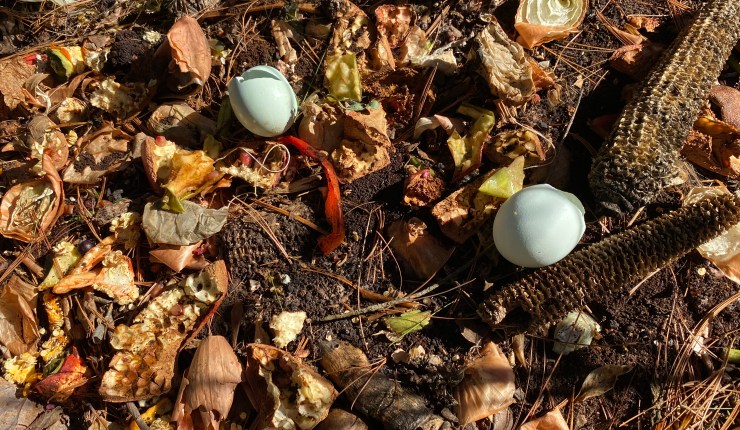
Hi everyone! Most of you have probably heard of composting. Its a method of recycling organic items, such as vegetable scraps, so that they don’t end up in landfills. My family has a low maintenance compost pile in our backyard, and many other people have compost bins that they use to create nutrient-rich garden soil. Here I’ll answer some questions about the benefits of composting, what can be composted, how to compost in an apartment, and compost’s uses.
Why compost?
Composting is good for the environment because it prevents food waste and other organic material from going to landfills. Landfills take up space and produce methane that contributes to climate change. In addition, compost has many uses, including replenishing soil and nourishing gardens (Dempsey).
How can I compost?
Composting is fairly easy. My family has a low-maintenance compost pile behind our house where we throw most of our food scraps and yard waste, including egg shells, vegetable peels, and dried leaves. We ignore it most of the time, but occasionally we churn it and put some of its soil into our garden.
My family’s composting method is useful for anyone who has enough land. However, many people live in apartments or have small yards where they cannot keep large piles of rotting vegetation. Luckily, there are other methods to compost in apartments.

Composting in an Apartment
There are multiple ways to compost in an apartment, including old fashion bins, worm bins, compost tumblers, electric composters, and community composting.
- Old fashioned compost bins are fairly self explanatory. A person can buy one online or simply modify a trash can or similar container. A good size for a compost bin is three feet square. In order for compost to decompose properly without smelling, it needs a balance of browns, or carbon-rich materials, and greens, or nitrogen-rich materials. It is also helpful to keep one’s bin damp and turn it regularly (“How to Use a Compost Bin”).
- Worm bins are different than old fashioned compost bins in that they only involve putting newspaper, dirt, compost, and worms into a plastic bin. The worms process the compost, and the bins themselves are small. A good worm bin size is about 15 inches deep by 25 inches wide (Dempsey).
- Compost tumblers are bins that are turned by hand cranks. They are small and require less maintenance than old fashioned compost bins (Dempsey).
- Electric composters disintegrate compost by grinding it to a pulp. They have no smell, easily get rid of food waste, and process items that are difficult to compost, such as meat scraps and avocado stones. Afterwards, the byproducts of electric composters can be used as fertilizer. Unfortunately, electric composters are very expensive (Dempsey).
- Community composting comes in handy if a person’s apartment building or town has a designated space for it, such as on the roof of a building or next to a community garden. In addition, people can buy into composting services, which are similar to trash removal services.
What can be composted?
As a rule of thumb, compost is nontoxic organic material. My family regularly composts fruit and veggie scraps, egg shells, coffee grounds, stale bread, dropped pasta, dead flowers, and hair, and occasionally composts paper and dead leaves. Other potentially compostable items include paper, yarn, and thread (“What CAN Be Composted in a Home Composting Bin?”). If a person is using a bin, they need to balance their browns, or carbon-rich materials, with their greens, or nitrogen-rich materials. Greens include fruit and veggie scraps, yard waste, teabags, coffee grounds, and manure, while browns include scrap paper, non-glossy newspaper, dry yard waste, straw, sawdust, and egg cartons. In general, it is smart to have twice the browns in one’s compost bin as greens, which keeps it from smelling (“How to Use a Compost Bin”).
Radical Composting: Terramation
Did you know that some people opt for their remains to be composted? Terramation, or human composting, is an environmental end-of-life alternative to burial or cremation (O’Donnell). It involves composting human remains in a steel vessel with straw, alfalfa, and wood chips to produce garden soil. Families of the deceased can take the compost home and use it for conservation projects or to start a memorial garden or orchard (Bush). So far, terramation is legal in Washington, Colorado, Vermont, and California. It is fairly new but is becoming more common, as evidenced by 1,200 people who have signed up to have their remains composted by Recompose, a company in Seattle (O’Donnell).When is it safe to compost paper?
Paper is a helpful compost component because it absorbs moisture and is a source of carbon. However, it is bad to compost papers that are heavily inked, have special coatings, or have been in contact with man-made chemicals. Papers that are usually safe to compost include newspaper, printer paper, cardboard, shredded paper, greasy paper, plain tissue paper, and envelopes. On the other hand, papers that usually shouldn’t be composted include greaseproof paper, heavily inked paper, glossy paper, receipts, and any paper that has chemicals on it (“What papers can be composted and why?”).
What can’t be composted?
Anything with dangerous chemicals or germs shouldn’t be composted. Items to avoid composting include plants contaminated with herbicides and pesticides, diseased plants and leaves, pet and human feces, lime, coal, pressure treated lumber, and paper with excessive inks (“What CAN Be Composted in a Home Composting Bin?”).
Radical Composting: Composting Toilets
Although human and animal waste is too toxic to compost in a pile or bin, it can be dealt with by a composting toilet. Composting toilets collect human waste and turn it into a humus-like substance. Contrary to how they might sound, composting toilets are sanitary and odorless. They are also much better for the environment. They create a nontoxic fertilizer, while ordinary sewage systems frequently create water pollution. In addition, they greatly reduce water consumption since flush toilets are responsible for around 30% of households’ water usage. The toilets can be either portable or permanent and are especially useful in remote places that have neither town sewer systems nor septic tanks (Vartan).Some items are bad to compost, but are not necessarily bad for the environment. Pine needles, wood ash, and charcoal shouldn’t be added to a compost pile because they decompose poorly and are not good for new soil. In addition, animal products can technically be composted, but are usually not because they smell and attract animals. Products that are not typically put in compost include meat, fish, bones, dairy, eggs, and grease (“What CAN Be Composted in a Home Composting Bin?”). Other reasons most people avoid composting meat are that mushy meat restricts airflow and feeds anaerobic bacteria that produce unwanted odor and acidity (Boyd).
Meat: To Compost Or Not To Compost
Although most people avoid composting meat, it can be done in a compost pile that is hot and well-aerated. The pile should reach a temperature of about 140 to 160 degrees Farenheit at least once a week(Boyd). While 140 to 160 degrees Farenheit sounds extreme, bacteria will naturally heat up compost to over 130 degrees Farenheit as long as the pile has a good balance of greens and browns and is around 3 feet deep (“How do I heat up my compost pile?”). Before a person puts raw meat in their compost, they should precook it to kill E. coli and other dangerous bacteria and cut it into small pieces. It is important that they turn their compost pile frequently and keep the meat scraps in its middle (Boyd).
Conclusions
I hope this has been helpful for those of you who want to understand composting better and are interested in having your own pile or bin. I am personally inspired to compost paper in my family’s pile.
Sources
Here are my sources for this blog post. Feel free to look them up for more information!
Bush, Evan. “’I’ve always wanted to be a tree’: Human composting starts to catch on.” NBC News, Sept. 27, 2022, nbcnews.com/science/science-news/ve-always-wanted-tree-human-composting-starts- catch-rcna48653. Accessed Oct. 25, 2022.
Dempsey, Eilidh. “How to Compost in an Apartment: 4 Options and Tips.” Utopia, Sept. 29, 2021, utopia.org/guide/how-to-compost-in-an-apartment-4-options-tips/. Accessed Oct. 24, 2022.
“How do I heat up my compost pile?” Compost Guide, Jul. 20, 2022, compostguide.com/how-to-heat- up-compost-pile/. Accessed Nov. 17, 2022.
“How to Use a Compost Bin (Beginner’s Step-By-Step Guide).” Help Me Compost, helpmecompost.com/home-composting/implementation/how-to-use-a-compost-bin/. Accessed Oct. 24, 2022.
O’Donnell, Noreen and Meghan McDonough. “Natural Burials, Human Composting: Going Green Even in Death.” NBC10 Philadelphia, Oct. 4, 2022, nbcphiladelphia.com/news/national- international/natural-burials-human-composting-going-green-even-in-death/3381791/. Accessed Oct. 25, 2022.
Vartan, Starre. “How Does a Composting Toilet Work?” Treehugger, Apr. 4, 2022, treehugger.com/how-to-use-a-composting-toilet-5190290. Accessed Oct. 24, 2022.
“What CAN Be Composted in a Home Composting Bin?” NC State Extension Publications, content.ces.ncsu.edu/what-can-be-home-composted. Accessed Oct. 24, 2022.
 Owl Tree View