
Hi everyone! You may have read articles about charismatic predators, such as lions and tigers, being on the verge of extinction. In addition, you may have heard about the controversy over reintroducing wolves to Yellowstone National Park in the 1990s. If you’re like me, you’ve probably wondered if the decreasing numbers of predators is a devastating loss to ecosystems or if their demise simply makes the world a safer place for humans. I wanted to do a post on this fascinating topic.
Predators’ Roles in Ecosystems
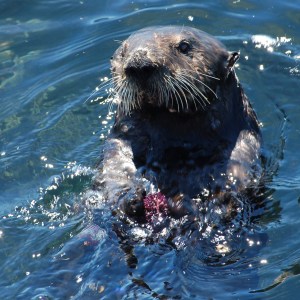
Predators’ main role in ecosystems is to rule from the top down, as opposed to producers, who rule from the bottom up. Apex predators keep other consumers in check so they don’t eat producers to extinction. In fact, if an ecosystem’s apex predators are removed, it could cause a trophic cascade, or a major series of changes to the rest of the food web. It could even cause an ecosystem to collapse. For example, humans hunting sea otters decimated kelp forests around the Aleutian Islands. Otters normally eat sea urchins, which feed on kelp. When the otters went extinct in certain areas, urchins multiplied and ate all the kelp. When the otters eventually returned, they reduced the number of sea urchins, allowing “luxuriant” regrowth of kelp. A similar situation happened in Venezuela. In the 1980s, a new dam flooded a valley, creating islands. Before the flood, apex predators like jaguars, mountain lions, harpy eagles, and armadillos left the area. As a result, the islands turned into a hellscape. Howler monkeys living there multiplied out of control and then went mad. In order to defend themselves from being eaten by the monkeys, plants grew thorns and increased their toxicity. Leaf-cutter ants were no longer being preyed on by armadillos, so they carried all the leaves on the islands into their holes, starving the soil of nutrients. Clearly, the ecosystems of the islands collapsed without apex predators (Fraser).
What are some of apex predators’ important roles in ecosystems?
- Apex predators reduce populations of herbivores, preventing them from overeating and decimating ecosystems. For instance, wolves reduce populations of elk, which prevent the elk from eating too many saplings. As a result, more saplings grow to maturity, providing habitat for other animals and soaking up water to prevent floods (“The Importance of Apex Predators for a Healthy Ecosystem”). Ecosystems have delicate checks and balances between predators and prey that likely evolved over millions of years (Dolph). If those balances are upset, it could upend an entire ecosystem.
- As well as eating herbivores, apex predators also eat mesopredators, keeping those populations in check. Mesopredators are mid sized predators like cats and raccoons that are in middle trophic levels. If all the apex predators in an ecosystem die out, mesopredators take over and run rampant. As an illustration, a reduction in lion and leopard populations in Ghana caused olive baboon populations to soar. The baboons are now wildly attacking livestock, damaging crops, and spreading intestinal parasites (Fraser).
- Ironically, the best way apex predators keep herbivores and mesopredators in check is not by eating them, but by creating landscapes of fear that keep them moving. On their own, elk herds will stay in one place and eat all the vegetation there. However, if there are wolves nearby, the elk will browse and then keep moving to look for cover. They will leave small plants and grasses for smaller herbivores and eat less saplings, which ultimately reduces flooding (“The Importance of Apex Predators for a Healthy Ecosystem”). The same principle occurs with mesopredators. On British Columbia’s Gulf Islands, raccoons were eating songbirds, intertidal crabs, and certain fish to near extinction. The raccoons were unafraid since the last large carnivores on the islands had been killed a century before. Then, a research team set up speakers that played dog vocalizations along the shoreline. When raccoons went to those areas to feed, they either left quickly or reduced their foraging. The raccoons’ feeding time was so reduced that the songbird, crab, and fish populations were able to rebound (Mandel). The fear that hearing dogs produced in the raccoons was enough to keep them in check.
- Apex predators can help prey populations by weeding out slow, weak, and diseased animals, which increases the health of the prey populations as a whole (“The Importance of Apex Predators for a Healthy Ecosystem”).
- Apex predators can increase the biodiversity of ecosystems. When wolves were reintroduced to Yellowstone in the 1990s, they controlled the park’s elk, which meant that the elk ate less saplings. As a result, willows and other trees grew on the banks of the streams, cooling the water. The cool water allowed trout and beavers to return for the first time after the vegetation had been decimated by elk. The beavers built dams, which created new ponds. Soon, amphibians and songbirds moved in to enjoy the ponds. The reintroduction of wolves ultimately led to an increase in biodiversity across the whole ecosystem (Fraser).

grasshopper. Part of the article
“Jumping spider” on Wikipedia.
Courtesy of Wikipedia and
Jee & Rani Nature Photography.
Creepy Crawlies: How Spiders Effect the Vegetation In Their Areas
Spiders are tiny apex predators that prey on insects. Whether they are active hunters or ambush hunters determines the composition of plant communities and the nitrogen levels in their areas. If an area has spiders that actively hunt, they reduce its grasshopper density. As a result, grass and goldenrod dominate since they are being eaten by less grasshoppers. That increases the availability of nitrogen in the area. On the other hand, if an area has spider species that ambush hunt, they will simply force grasshoppers to shelter in goldenrod instead of grass. That leads to a diverse plant community with less available nitrogen (Fraser). Spiders may be small, but they exert impressive control over their ecosystems.
What about dangerous apex predators?
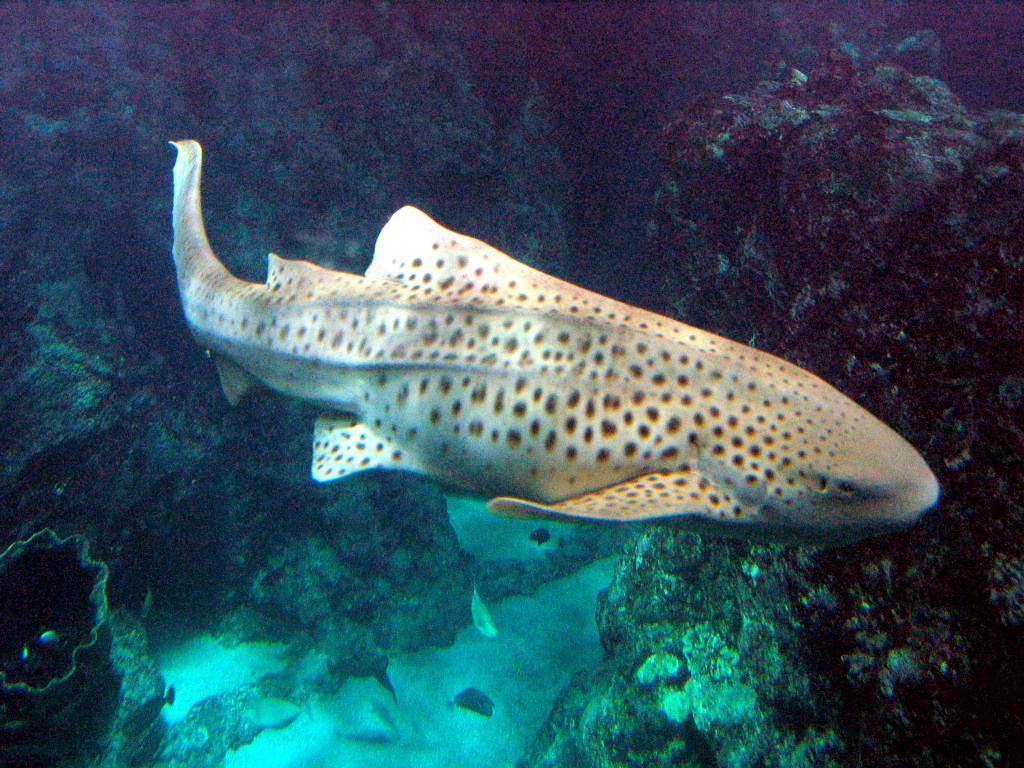
Sometimes conserving apex predators can be controversial since those predators are seen as menaces to humans. Sharks are one type of apex predator that are portrayed as deadly monsters in popular culture. However, sharks are actually beneficial to both ocean ecosystems and humans.
What are the benefits of sharks in ocean ecosystems?
Surprisingly, sharks are some of the most vital organisms for the health of ocean ecosystems. There are over 500 species of sharks worldwide. Each species has a different diet, set of behaviors, and role in its ecosystem. Some of sharks’ most important roles are preserving coral reefs, bivalves, and seagrass meadows.
Coral reefs contain one quarter of the world’s marine life. In reef food webs, sharks eat predatory fish like groupers, which eat herbivorous fish that feed on algae. If an area has few sharks, there will be an explosion of groupers, which in turn will eat most of the herbivorous fish. The lack of herbivorous fish will cause an explosion of algae. If the algae in a reef overgrows too much, it will suffocate the corals and kill the reef. That is currently a major problem in Jamaica, where a drop in shark populations has led to the decimation of the island’s coral reefs (“How Do Sharks Help the Ecosystem?”).
Sharks also protect bivalves. Bivalves, such as mussels, scallops, and clams, act as the ocean’s filtration system. They filter phytoplankton out of the water to eat and while doing so, clean the ocean. Bivalves are eaten by Cownose rays. Sharks normally hunt the rays, but if there are no sharks in an area, the rays devour the bivalve population. That leaves the area with no water purification (“How Do Sharks Help the Ecosystem?”).
Finally, sharks preserve seagrass meadows by keeping the turtles and dugongs that eat seagrass moving along. Seagrass meadows store huge amounts of carbon that would otherwise be released into the atmosphere or ocean. As well as accelerating climate change in the atmosphere, carbon dissolved in the ocean makes the water more acidic and harms the organisms that live there (“How Do Sharks Help the Ecosystem?”).
Are sharks dangerous to humans?
Due to the portrayal of sharks in popular culture, people see them as major threats. However, sharks attacks in real life are rare. In 2021, 112 bites on humans were reported worldwide. Nine of those cases were fatal (“International Shark Attack File”). On average, there are about six recorded fatalities from shark attacks per year (Edwards). There may also be a number of unrecorded shark fatalities in developing countries. However, considering that there are 1 billion sharks and 8 billion people worldwide (“How Many Sharks Are In The World?”), six recorded fatalities is fairly small. Fatality rates from shark bites have been declining for decades due to increased public awareness, improved medical treatment, and better beach safety protocols (“International Shark Attack File”). While shark attacks are rare, sharks are dangerous animals so people should educate themselves on shark safety and beach protocols before they swim in the ocean or take part in water sports.
While sharks are rarely a danger to humans, humans are a massive danger to sharks. Roughly 100 million sharks are killed by humans each year (Sen), which is one tenth of the world’s current shark population (“How Many Sharks Are In The World?”). As a result, an estimated 25% of shark and ray species are threatened with extinction. Sharks are killed for a number of reasons. One of the main ways humans kill sharks is shark finning. Shark fins are used in shark fin soup, a delicacy in some places. Unfortunately, shark finning is very cruel. After fishers catch a shark, they will usually saw its fins off while it is still alive. Then, they will toss it overboard. The live shark cannot swim without its fins, so it sinks and drowns. Shark finning is illegal in 70 countries and regional bodies, but it is not illegal globally. Many other sharks are killed from being caught as bycatch. Bycatch are marine animals that are accidently caught in fishing nets. Estimated tens of millions of sharks are killed each year from being bycatch. A third cause of the decline of the shark population is nursery and habitat destruction from coastal development and destruction of coral reefs and mangrove swamps (Sen). People need to remember that the ocean is the sharks’ home. When humans enter the water, they are doing so at their own risk. A decline in shark populations should not be seen as a benefit to humans, but rather a danger to aquatic ecosystems.
Sharks are actually very helpful to humans. Shark related tourism is a boon to countries’ economies. It contributes about 113.8 million USD to the economy of the Bahamas annually (Sen), as well as 42.2 million USD to Fiji (Sen) and 25.5 million USD to Australia. Reef related tourism is an even bigger money maker, with Australia receiving billions of dollars from it every year (“How Do Sharks Help the Ecosystem?”). Sharks also protect types of seafood that humans eat. A decrease in sharks along the eastern seaboard led to an explosion of rays that killed an old scallop fishery. If sharks had been protected in the area, the fishery would have remained intact (Fraser).
The best ways for humans to protect sharks are only buying certified sustainable seafood, avoiding shark meat and products, and encouraging the creation of Marine Protected Areas along coastlines. Shark products to avoid include liver oil, jaws, teeth, shark leather, and flake, which is shark meat (Sen).
Human Deaths Caused by Apex Land Predators Versus Other Animals
This chart compares the numbers of human deaths caused by wolves and lions versus the numbers of deaths caused by other animals.
| Animal | Number of Humans It Kills Annually |
| mosquitoes | 725,000* |
| humans | 475,000* |
| wolves | 2–10 *, ** |
| deer | 120 in the United States (mainly through car accidents)* |
| lions | 200*** |
| hippopotamuses | 3,000*** |
| African elephants | 500*** |
| Cape Buffalo | 200*** |
Just because an animal is an apex predator does not mean it is more dangerous than some herbivores. Hippopotamuses, which are a prey of lions, actually kill 15 times more humans than lions themselves. The most dangerous animals in the world are mosquitoes and humans.
Conclusion
This post covered the benefits of conserving apex predators and also statistics on how dangerous certain predators are to humans. I find this information fascinating and want to spread more awareness about the benefits of apex predators in the future. Feel free to share this post, comment on it below, or check out some of my other blog articles!
Sources
Here are the sources I used for this post. Feel free to check them out!
“ARE WOLVES DANGEROUS TO HUMANS? The risks associated with a wolf attacking a human are ‘above zero, but far too low to calculate,’ a new report says.” International Wolf Center, http://www.wolf.org/wolf-info/factsvsfiction/are-wolves-dangerous-to-humans/. Accessed Jan. 25, 2023.
Cutolo, Morgan. “22 Animals That Are Deadlier Than Sharks.” Reader’s Digest, Juliana LaBianca, Nov. 28, 2022, www.rd.com/list/animals-that-are-deadlier-than-sharks/. Accessed Jan. 25, 2023.
Dolph, Mara. “What Happens When the Top Predator Is Removed From an Ecosystem?” seattle pi, http://www.education.seattlepi.com/happens-top-predator-removed-ecosystem-3496.html. Accessed Jan. 23, 2023.
Edwards, Charlotte. “KILLER INSTINCT: World’s deadliest animals ranked by number of humans killed – and snails are number 5 on list.” The Sun, www.thesun.co.uk/tech/10450075/worlds- deadliest-animals-ranked. Accessed Jan. 25, 2023.
Fraser, Caroline. “The Crucial Role of Predators: A New Perspective on Ecology.” Yale Environment 360, Yale School of the Environment, Sept. 15, 2011, http://www.e360.yale.edu/features/the_crucial_role_of_predators_a_new_perspective_on_ecology. Accessed Jan. 20, 2023.
“How Do Sharks Help The Ecosystem?” Our Endangered World, Nov. 22, 2022, www.ourendangeredworld.com/species/how-do-sharks-help-the-ecosystem/. Accessed Jan. 24, 2023.
“How Many Sharks Are In The World?” NW: NMK WORLD, Jul. 7, 2022, www.nmk.world/how-many- sharks-are-in-the-world-148923/. Accessed Jan. 25, 2023.
“International Shark Attack File: Yearly Worldwide Shark Attack Summary: The ISAF 2021 shark attack report.” Florida Museum, www.floridamuseum.ufl.edu/shark-attacks/yearly-worldwide- summary/. Accessed Jan. 25, 2023.
Mandel, Charles. “How top predators enforce balance in the ecosystem.” Canada’s National Observer, Feb. 23, 2016, www.nationalobserver.com/2016/02/23/news/fear-factor-how-top-predators- enforce-balance-ecosystem. Accessed Jan. 23, 2023.
“Most Dangerous Animals In Africa: the 10 deadliest animals in africa.” Safaris Africana, www.safarisafricana.com/most-dangerous-animals-africa/. Accessed Jan. 28, 2023.
Sen, Ria. “Sharks: Friends not foes!” IUCN, Nov. 5, 2018, www.iucn.org/news/asia/201811/sharks- friends-not-foes. Accessed Jan. 25, 2023.
“The Importance of Apex Predators for a Healthy Ecosystem.” greener ideal, Jun. 11, 2010, www.greenerideal.com/news/environment/7066-the-importance-of-apex-predators/. Accessed Jan. 23, 2023.

 Owl Tree View
This is awesome!
LikeLike
Thank you!
LikeLike
A wonderful article on the importance of apex predators. It’s amazing how intricately linked ecosystems are, and how one element that may seem totally unrelated from another can have a real effect on another element, such as wolves and water quality of streams. The absence of important apex predators from many regions where they once thrived, such as wolves from the majority of the United States, makes me wonder how their absence has impacted the ecosystem. Are prey species kept in check by hunters and other artificial means of control? Are large animals such as deer depressing ecosystems by uprooting plants, degrading habitat, and causing car accidents because of their overabundance? I know that in many areas deer are far overpopulated, which is surely causing a number of issues in the ecosystem. Hunters shouldn’t be the solution to the problem, however, the decrease in the number of hunters since the 20th century suggests that the problem of deer without many apex predators could be exacerbated. I don’t know much of the issue, but introducing apex predators again into historic habitat, such as wolves into Maine, Vermont, and New Hampshire, could be a solution. Anyways, just food for thought. Thanks for the article.
References:
Rott, N. (2018, March 20). Decline In Hunters Threatens How U.S. Pays For Conservation. NPR. Retrieved March 14, 2023, from https://www.npr.org/2018/03/20/593001800/decline-in-hunters-threatens-how-u-s-pays-for-conservation
LikeLike
I agree! A decline in hunting has probably exacerbated the problem of too many deer, but hunters can’t be the only solution to the problem. I’ve also heard of people putting contraceptives in salt licks to control the deer population, but that only works to a point too.
I’m glad you liked the article!
LikeLike
No problem! You have a great cite here.
LikeLike